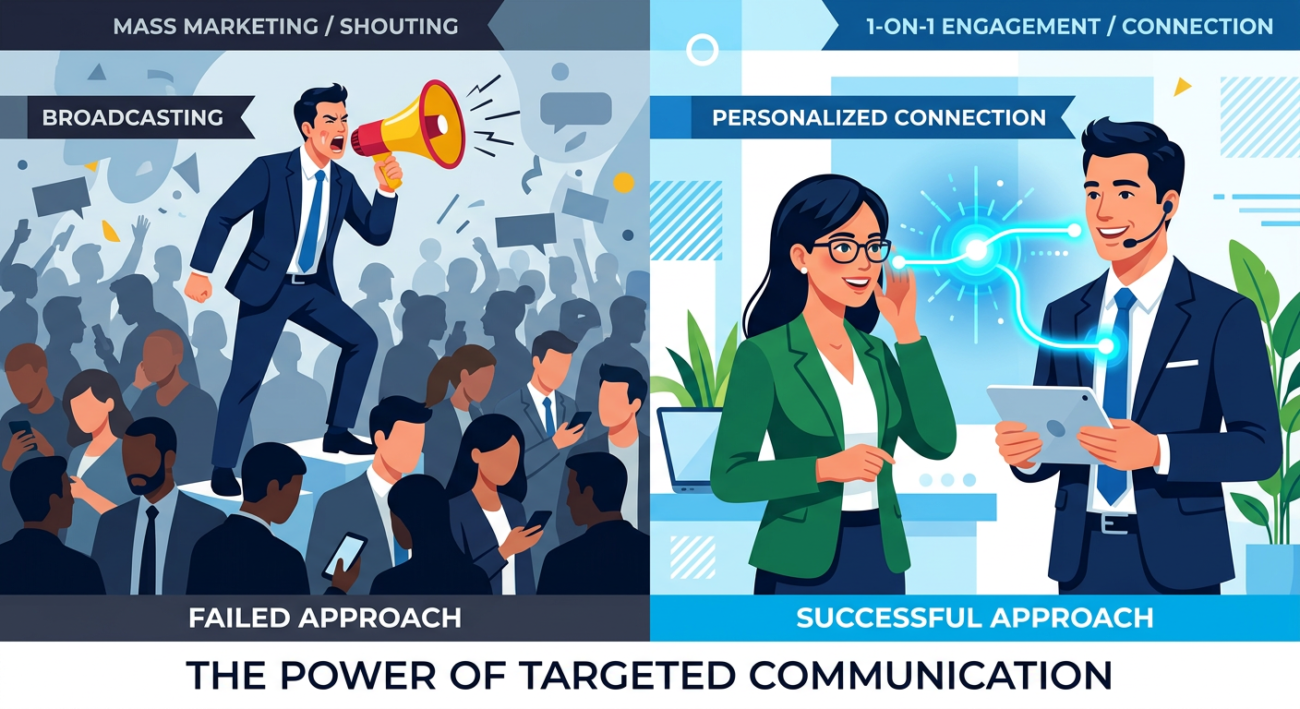
Why does the desire to sell to everyone fail in marketing?
Every business owner has one thought in their mind – “Everyone should like my product, everyone should buy it.” This is a natural desire. Because it is not wrong to think that the product or service we have worked hard to create should reach as many people as possible. But this same thought often leads to a big mistake in marketing.
A small businessman tries to sell his product to everyone in the village. Telling the same thing to a young person, explaining it to an old person in the same way, using the same words to a student – all of these may not work in the end. Because every person has different needs, different ideas, different spending capacity, different tastes. However, if we try to reach everyone in the same way, the message will be weakened.
- Marketing is not just about advertising.
- It is about understanding who we are serving.
- Although the concept of “everyone is my customer” may seem great at first, it actually indicates a lack of deep understanding.
- If you want to speak to everyone, there will be no sharpness in the words.
- If you design a product to suit everyone, it will not be unique.
In experience, small businesses often make this mistake. They think – “Anyone can buy it, so let’s show it to everyone.” But in reality, only a few people buy it. The rest may not need it. As a result, costs increase, results decrease, and frustration sets in.
In this article, we will learn – why is it dangerous to try to sell to everyone? Who should you target? How to bring clarity? How can you understand it through calculations? Let’s take a closer look at this issue with practical examples.
1. The hidden danger of the concept of “everyone is a customer
The first step in marketing is to determine the target group. But many people skip this step and start advertising directly. Because they have a misconception – if you show it to more people, you will get more sales. Although this may seem correct according to the calculations, it does not work in reality.
Let’s take an example. Let’s say you are making a special food product that is good for health. Let’s say it is especially useful for people with diabetes. But if you say in your ad,
“This is good for everyone,”
it won’t seem special to anyone except those who are health conscious. If you say, “Food that helps people with diabetes,” the target audience will respond immediately.
The main problem with trying to sell to everyone is the lack of clarity. The message usually changes. The uniqueness disappears. When a person is looking for a solution to his problem, he needs clear words. The phrase “This is for everyone” does not make sense to him.
- Another problem is cost.
- If you want to reach everyone, the campaign must be broad.
- Different ages, regions, needs – all have to be reached in different ways. This wastes time, effort, and money. In the end, it is also difficult to determine who is really interested.
- In addition, the design of the product also becomes confusing.
- If you make it appealing to the young, the elderly may not like it.
- If you try to make it cheaper, the quality may decrease.
- If you make it more expensive, some may not be available.
- If you try to make it suitable for everyone, it becomes mediocre. Mediocrity means lack of uniqueness.
Clarity is the key to success in marketing. Only when you clearly know who you are serving will your words, design, price, service – everything go in the right direction.
2. Target Group Selection: The Power of Deep Understanding
Target group selection does not mean leaving out some people. It means giving full attention to the right people. A farmer does not apply the same type of fertilizer to every plant in his field. He knows which fertilizer is needed for which crop. Similarly, understanding the target group is very important in business.
Three factors should be considered to determine the target group: need, ability, interest. If a person does not need it, he will not buy. If he has a need but does not have the ability to buy, he will not buy. If he has a need and ability but does not have the interest, he will not show interest.
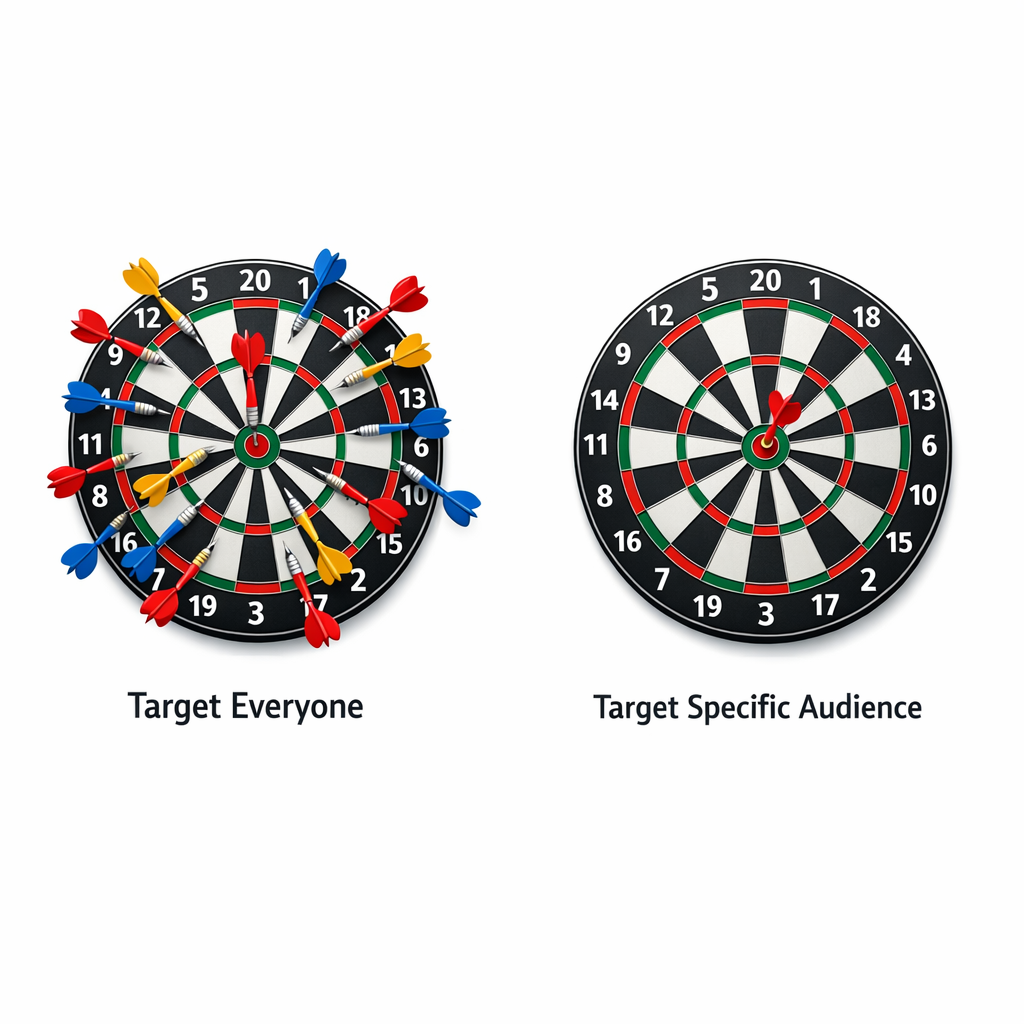
Comparison 1: Big net vs small net
A fisherman wants to cast a big net in the sea and catch all kinds of fish. But if he needs a specific fish, he casts a small, appropriate net in the area where that fish is. The big net also brings unnecessary things. Time is wasted. The goal is clear in a small net.
Similarly, in marketing, a small target group means a clear result. A large group means confusion.
Comparison 2: General doctor vs specialist
A general doctor sees all diseases. But a cardiologist focuses only on heart problems. Who do people with heart problems look for? A specialist. Because he has clear knowledge. Similarly, a business should also focus on a problem.
When you choose a target group, you will be able to speak their language. You will be able to understand their problem in depth and provide a solution. This depth increases trust. When trust increases, a long-term relationship is formed.
Understanding through calculations
Let’s do a simple calculation.
Number 1:
Total population = 10,000
Purchasing interest rate = 2%
Sales = 10,000 x 2/100
Sales = 200
Number 2:
Target group = 2,000
Purchasing interest rate = 10%
Sales = 2,000 x 10/100
Sales = 200
The thing to note here is – there is less interest in a large group. There is more interest in a small group. In both cases, the sales were equal to 200. But in the second case, the cost is less, the effort is less, and the result is clear.
Let’s do another calculation.
Advertising cost per person = Rs. 10
Large group cost = 10,000 x 10 = Rs. 1,00,000
Small group cost = 2,000 x 10 = Rs. 20,000
Although the sales are the same in both, the second method is profitable. This is the power of the target group.
Practical Examples
- A clothing store in a small town advertised “clothes for everyone.”
- It had children’s clothing, youth clothing, and senior citizen clothing – it had everything.
- But there was no specialization in any department.
- Another store in the same town clearly advertised “special children’s clothing.”
- Parents started going straight to that store.
- Because they clearly found what they wanted there.
Let’s take another example of a training center. It advertised training for all exams. But a small center said “special training for police recruitment exams.” Where did the targeted students go? Where there is specificity.
The point to note here is – specificity is attraction. Clarity is trust.
Conclusion
The key to success in business is clarity. While the concept of “everyone is my customer” may sound great at first, it is not a deep strategy. It is just a wish. Business doesn’t run on hope. It runs on understanding.
Be clear about who you serve. Understand their problem. Speak their language. Build a strong bond with a small group. That bond turns into trust. Trust gives stability. Stability leads to growth.
External Links
https://www.inc.com/kevin-daum/why-you-shouldnt-try-to-sell-to-everyone.html
https://hbr.org/2016/05/know-your-customers-jobs-to-be-done
https://www.businessnewsdaily.com/15109-identify-your-customer-base.html

2 thoughts on “Why Trying to Sell Everyone Fails in Marketing”