Introduction
When we share any information, it only becomes relevant if we know **who we are trying to reach**. But many people, because they **don’t understand** who their writings, ideas, or stories are intended for, their efforts are less effective. This is not an uncommon problem, because each person is different in their thoughts, opinions, and goals. Therefore, the content we create **can only be relevant to a specific group**.
For example,
- let’s say a young woman writes an article about fitness.
- If that article reaches a 50-year-old, it may not be very useful for that group.
- If the same article reaches a young woman between the ages of 18–30, it becomes
- **an immediate guideline**.
- So, **identifying your audience** is not just about sending information;
- it is also **reaching the right people in the right way**.
We face three main problems in identifying the audience:
1. Lack of proper classification – If the group is large or broad, the article becomes confusing.
2. Ineffective amount of information – What suits one person’s needs may not be understood by another.
3. Uncertain answers– Not knowing what the group wants can also make writing ineffective.
Identifying the right audience requires **a combination of attention, observation, and calculations**. Through this article, I am going to explain to you **practical, statistically based, and empirical approaches**.
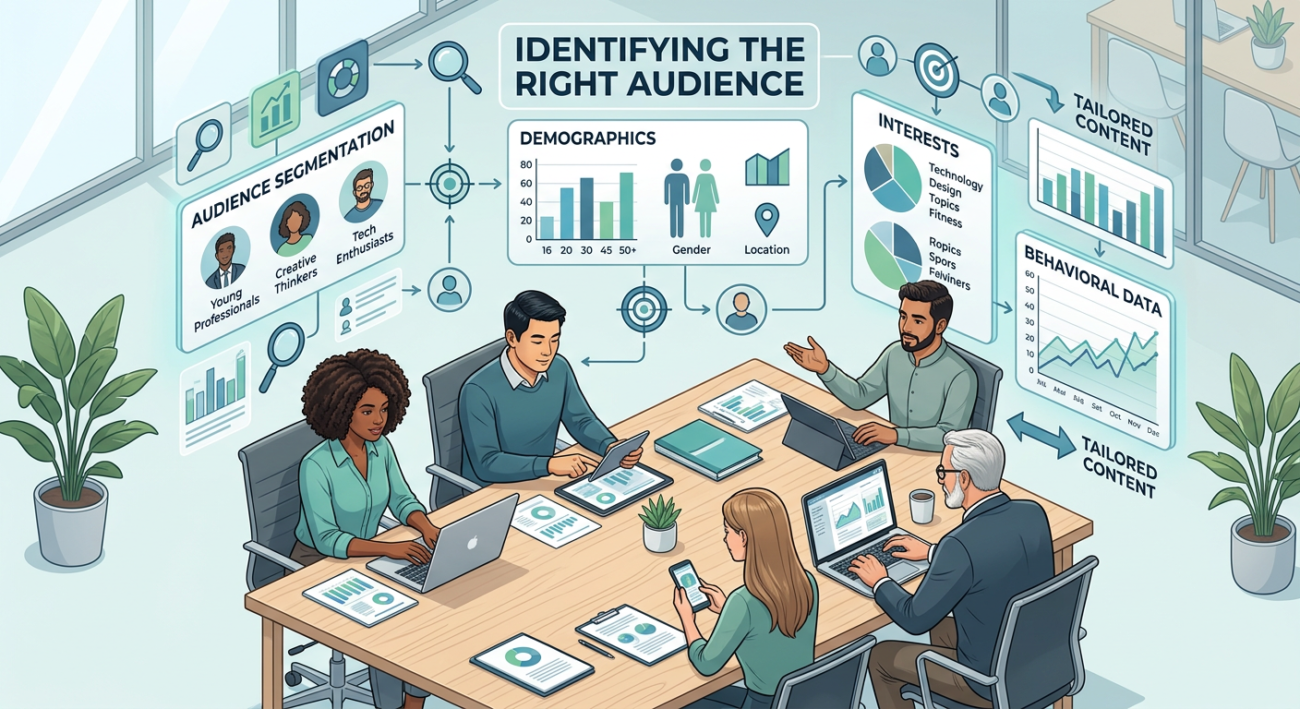
1. Segmenting the audience – age, gender, and interests
The first step in identifying the right audience is **understanding their preferences, age, and sexuality**. Each person has different attractions according to their age and sexuality.
Segmentation by Age
18–25 years: People in this age group generally like **new, temporary, and trendy things**. For example, social media trends, fitness tips, and tech gadgets.
26–40 years:This age group focuses on stability in life. Topics like **career development, finance, family, and health** are considered important for this age group.
41–60 years:People in this age group are more interested in **medical, wellness, wealth, and inheritance**.
60+ years:** This group generally focuses more on **comfort, wellness, and entertainment**.
Behavioral data such as how long users spend on a piece of content, where they click, and what kind of comments they make.
Through this data, we can understand audience engagement.
Example: Out of 1000 people who read an article, 600 spent only 1–2 minutes, which means that the article did not provide overall appeal to the reader.
Where to include: This section can be added as a short paragraph titled “How to use audience behavior for future articles.”
Segmentation by Gender
Men and women respond differently to the same topic. For example, when it comes to fitness topics, women generally prioritize **diet and health**, while men are more interested in **mass building, exercise routines**.
Hobbies and Personal Interests
- What do users like?
- What problem do they face?
- What industry are they in?
The answers to these questions can be found through **surveys, social media insights, and Google Trends**.
**Removal statistics:** According to a survey, 60% of people aged 18–35 are found to prefer **online videos and short-content** in 2023. At the same time, 70% of people aged 36–50 read **articles and news-based reports** the most.
2. Understand your audience with statistics and numbers
**Numbers, percentages, and trends** are key to understanding your audience.
So why is it necessary to use statistics?
1. **Real evidence:** Instead of just guessing, decisions can be made based on real data.
2. **Broad View:** You can find out what 60 people like out of 100 users.
3. **Measuring Results:** You can find out how many people respond to a type of content and how many people use it.
Statistics Example
Consider an article:
- *1000 people read the article
- * 600 of them are 18–30
- * 250 are 31–45
- * 150 are 46–60
This statistic shows: the article **is most appealing to people aged 18–30**.
**Comparison with numbers:**
* 18–30: 60%
* 31–45: 25%
* 46–60: 15%
Based on this data, future articles should be tailored **to the needs of people aged 18–30**.
3. Understanding the audience mindset through simple calculations
The calculation process is very simple. For example, a blog has 2000 readers. Among them:
* 1200 are young people (18–30)
* 500 are middle-aged (31–45)
* 300 are older (46–60)
**Percentage calculation:**
Percentage = (Number of people / Total readers) × 100
* Young people = (1200/2000) × 100 = 60%
* Middle-aged = (500/2000) × 100 = 25%
* Older people = (300/2000) × 100 = 15%
This clearly shows us **who the main audience is**.
Segmenting the audience – Age, Gender, and Interests” section.
Marital Status – Married and single people have different issues and interests.
Education Level – College students, graduates, and professionals like different things.
Geographical Location – People in rural areas may have different ideas than those in urban areas.
In this section, by including different categories in the form of diagrams, the reader will get a visual experience.
4. Practical Examples
1. An author writes a **fitness blog**. At first, he thought he could write for all ages. But after looking at the statistics, he noticed that his articles only attracted a large readership from **youth aged 18–35**.
2. A writer writes health-related articles. Statistics show that people aged 41–60 are most interested. So, the writer tailors subsequent articles to that age group.
5. Frequently Asked Questions (FAQ)
Question 1: How do we select the right audience for content?
Answer: Based on age, gender, interests, issues, and demographics.
Question 2: Can’t content be tailored to all ages?
Answer: It is possible, but content designed primarily for one age group is more effective.
Question 3: Are statistics necessary?
Answer: Yes, data-driven decisions are more effective.
Question 4: How to use surveys?
Answer: Surveys are useful for gathering reader interests, problems, and feedback.
Question 5: What should I do if I need to change the classification of an article?
Answer: Review the statistics and modify the content to meet the needs of the main audience.
Conclusion
Identifying the right audience is not just a technical process, it is an art, a mindset, and an experience. By knowing who we are speaking to, our efforts become more rewarding and meaningful.
Understanding the needs of an audience requires attention, statistics, observation, and long-term thinking. An article, story, or piece of information only creates value when it reaches the right group.
We know: instant results are never permanent. But by systematically observing, feedbacking, and using statistics correctly, we can always be successful.
By identifying the right audience, we can understand the problems and create solutions, and gradually every article, every lesson, every story will gain a standard place in society. This is a solid, systematic, and long-term path to success

One thought on “Know Your Customer for Your marketing Content”