Digital Payments
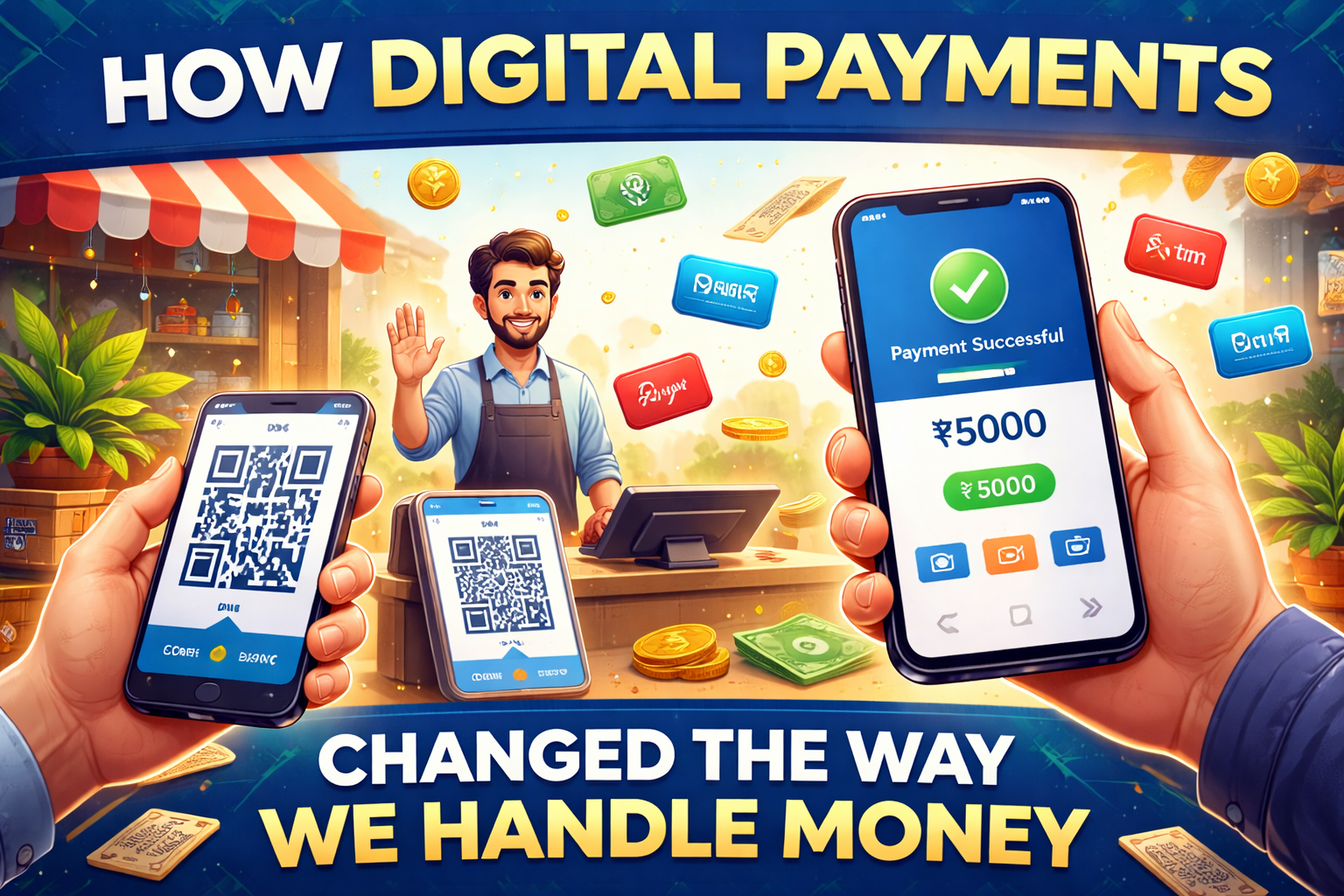
Digital Payments means sending, receiving and spending money through mobile, card or internet without cash in hand.After UPI (Unified Payments Interface) came in India, digital transactions have grown very fast. From a small tea shop to a large shopping mall, accepting payments via QR code has become commonplace.
Nowadays we pay even small amounts daily through digital. For example ₹10 tea, ₹20 parking, ₹100 grocery—all through UPI. It has completely changed the way we handle money.
Life Before Digital Payments
Before the advent of digital payments, we mainly depended on cash. This causes some problems:
- Long queues at the bank
- Lack of proper change
- Need to carry more cash
- Absence of transaction record
For example, if you buy a ₹30 item with a ₹500 note, the problem is if the shop doesn’t have change. Also, if you go to the bank 10 times a month and wait 30 minutes each time to withdraw money.
Mental stress was also high when living on cash basis. There was fear of theft and loss due to having large amount of money in hand.If the money was lost during the journey, the whole plan would have been disturbed. Digital payments have reduced this fear to a large extent. The account is safe even if the mobile is lost.
Calculation:
10 visits × 30 minutes = 300 minutes (5 hours)
That means 5 hours per month is spent just for money.
This time is completely saved with the advent of digital payments.
What are Digital Payments
Digital payments are sending or pending money electronically. Mainly used methods are:
- UPI (Apps like GPay, PhonePe, Paytm)
- Debit Cards
- Credit Cards
- Mobile Wallets
- Internet Banking
Money is transferred directly from our bank account through UPI. We spend the amount in our account through these type of Debit Card. We will pay later using the credit given by the bank first through Credit Card.
How Digital Payments Changed Daily Money Handling
Digital payments have made our daily life so much easier:
- Instant Payments: Complete transaction in seconds
- 24/7 Transactions: Send money anytime, anywhere
- No Physical Cash: No need to carry cash
- QR Code Usage: Scan with camera and pay
Small Payments Easy: Even small amounts can be paid immediately.Strong technology works behind digital payments. UPI transactions are processed in real time through the NPCI system.Digital payments have increased control over our spending then only the spending on daily needs are been increased. Every transaction is recorded in the App so it is clear where and how much was spent.
Understanding the expenses at the end of the month can help reduce unnecessary expenses. It increases personal financial discipline.
The use of encryption and 2-Factor Authentication ensures secure exchange of money.It’s not just an App — a complete financial network.
Practical Example :
Assuming 5 transactions per day, each transaction takes 10 minutes of going to the bank or ATM.
5 × 10 minutes = 50 minutes/day saved
Per month (30 days): 50 × 30 = 1500 minutes (25 hours)
That means digital payments save 25 hours of time per month.
Impact on Bussiness and Economy
Even small shops have embraced the technology thanks to digital payments:
- Even small tea shops are adopting UPI
- Online Business has increased
- Faster transactions
- Transparency has increased
As soon as the customer pays through the QR code, the money gets credited to the shop owner’s account. This reduces the risk of cash handling.Digital payments have increased transparency in businesses. Due to the fact that every transaction is recorded, duplicate calculations are reduced.This has improved tax collection for the government. This is an important reason for the strengthening of the country’s economy. Small businesses are also entering the formal economy.
Example:
If a small shop makes sales of ₹5,000 per day, per month:
₹5,000 × 30 = ₹1,50,000
This digital recording of the amount makes accounting easier and the bank has a transaction proof even while taking the loan.
Advantages of Digital Payments
- Easy & Convenient: With Just One Click
- Time Saving: Bank, ATM Needs Droped
- Secure Transactions: PIN, OTP, Biometric authentication
- Expense Tracking: How much you spend it would be shown in app
- Offers & Cashback: Sometimes You Get Cashback Also
Example:
Every Month Digital Offers ₹50 Cashback Will Get
₹50 × 12 months = ₹600/year Extra Saving
Digital payments are very useful in emergency situations. No need to search for an ATM at night or for unexpected expenses.
For example: If an emergency requires ₹2,000,
A 30 minute journey to find an ATM costs ₹50
Through digital payment → 0 minutes ₹0 spend
It also saves time and peace of mind.
Disadvantages of Digital Payments
- No transaction can happen without internet
- Fraud Risk (Risk of sharing OTP or PIN)
- Without Digital Literacy it is difficult to use
- Sometimes Server Issues
So for safety don’t share OTP with anyone, use official Apps only.Over reliance on digital payments can also become a problem. Payments stop when mobile battery and network problems occur.So it is better to keep some cash close and balance both digital-cash.
Real Life Example
Now even in villages, the greengrocer, the tea stall, the auto driver—everyone is keeping a QR code. If the customer takes out the mobile and scans it, the money will be immediately credited to the receiver’s account.
For example, if a street vendor takes an average of ₹30 from 100 customers per day:
100 × ₹30 = ₹3,000/day
Per month: ₹3,000 × 30 = ₹90,000
It’s all digitally recorded to reduce loss
Tips to Use Digital Payments Safely
- Do not share OTP, PIN with anyone
- Download Official Apps Only
- Do not transfer large amounts over public Wi-Fi
- Always check SMS Alerts
Most frauds are done through phone calls or fake links. Do not respond immediately if you receive messages saying “your account will be blocked”.Note that banks or UPI Apps never ask for OTP.
Conclusion
Digital payments have completely changed the way we use money. Time is saved, transactions are done faster, records can be easily tracked. From small shops to big businesses, everyone has benefited. But you can get full benefit only if you follow security precautions. Digital economy will become stronger in future.Digital payments will continue to evolve in the future. Technologies like AI-based fraud detection, voice-based payments, international UPI are coming.
India will become the strongest digital economy in the world if digital literacy increases.
External Links
https://www.digitalindia.gov.in
1 thought on “How Digital Payments Changed the 1 Way We Handle”