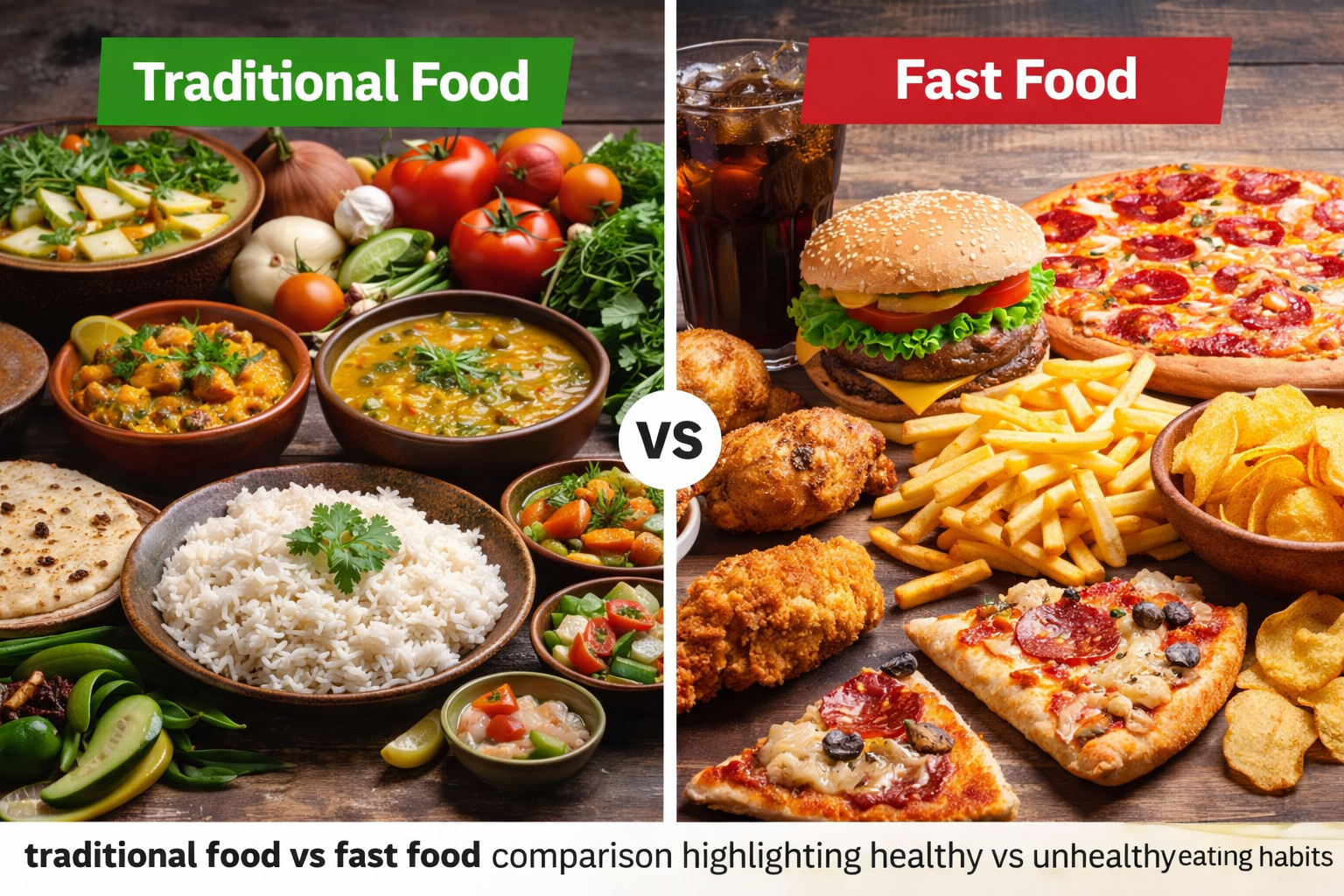
Nutritional Awareness in Modern Lifestyle
Food is not just an appetite suppressant. Our physical health, mental state, life span, energy level — all depend on our eating habits. The food that older generations ate was natural, less processed, and more nutritious. But in modern times due to increase in consumption of fast food and junk food, health problems have increased significantly.
Nowadays many people only care about calories but do not care about micronutrients (Vitamin B12, Iron, Zinc, Magnesium). Calories alone are not enough for the body to function properly, nutrients are needed.
For example:
Even if you consume 2000 calories a day, if there are no nutrients in it, the body becomes weak.
- That is: 2000 calories ≠ Healthy Body
- Balanced Nutrients = Healthy Body
- Protein requirement (average): Body weight × 0.8 grams
Example: 60 kg person → 60 × 0.8 = 48g protein per day required.
Traditional Food vs Modern Fast Food
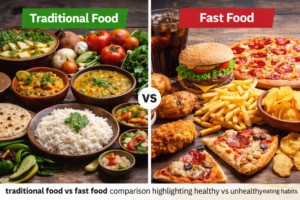
Traditional Food :
The food of older generations was made from natural ingredients. Foods like wheat bread, brown rice, vegetables, pulses and ghee provide protein, fiber and vitamins needed by the body.
Example: A typical home meal:
- Rice (1 cup) → 200 calories
- Lentil → 120 calories
- Curry → 80 calories
Total ≈ 400 calories (balanced nutrients)
It gives energy to the body but does not give excess fat.
Older generations’ diets were high in fiber (millets, pulses, vegetables).
At least 25–30g of fiber per day is required.
A day’s fiber intake is as follows:
- 1 cup cinnamon powder → 8g
- 1 apple → 4g
- 1 cup of vegetables → 6g
- Total ≈ 18g
Even less. So processed food should be reduced.
If fiber is low:
- Constipation
- Colon problems
- Weight gain
Modern Fast Food :
Fast food is high in processed oil, high in salt and sugar.
Example: A Burger French Fries Cold Drink:
- Burger → 350 calories
- Fries → 300 calories
- Drink → 150 calories
- Total ≈ 800 calories
That’s twice as many calories as a regular home meal.
Eat this daily:
800 × 30 days = 24,000 extra calories
≈ 7,700 calories are needed to gain 1 kg of weight
That means you can gain weight up to ≈ 3 kg in a month.
Increase in LifeStyle Diseases
Problems caused by modern diet:
- Obesity
- Diabetes
- High BP
- Heart Disease
- Fatty Liver
Example:
2 teaspoons of added sugar 3 times a day:
1 teaspoon ≈ 16 calories
2 × 3 × 16 = 96 calories per day
96 × 365 = 35,040 calories per year
This is enough for a weight gain of ≈ 4–5 kg.
Most people ignore liquid calories.
- A cold drink (300ml) ≈ 150 calories
- If you drink 1 bottle a day:
- 150 × 30 = 4500 calories/month
- 4500 ÷ 7700 ≈ 0.5 kg weight gain
- May gain ≈ 6 kg weight per year.
This is something that many people don’t know.
Effect on Mental Health and Mood
Our diet affects brain function. Dopamine temporarily increases when junk diet is eaten. But if it is a habit then the natural state of the brain is reduced.
- High sugar causes:
- Mood swings
- Decrease in concentration
- Aggression increases
- Symptoms of Depression
A balanced diet keeps the brain functioning properly.
Gut-Brain Connection
There is a direct connection between our gut and brain. This is called “Gut-Brain Axis”.
Taking Probiotic foods (Curd, Buttermilk):
- Stress is reduced
- Mood stabilizes
- Digestion improves
Processed diet imbalances gut bacteria. This increases anxiety and irritation.
Irregular Eating Habits & Digestive Problems
Due to irregular diet:
- Acidity
- Gas problem
- Constipation
- Bloating
Skipping meals throughout the day and eating more at night slows digestion.
Example: If a person consumes 1000 calories in one night,
The body cannot fully use it and stores it as fat.
If this happens 10 times in a month:
- 1000 × 10 = 10,000 extra calories
- ≈ 1.3 kg weight gain.
Impact on Children and Teenagers
Young children and teenagers are more attracted to junk things.
Because of:
- Poor Immunity
- Obesity at young age
- Attention problems
- Early diabetes risk
If the child does not have proper nutrients during the growth stage, it will lead to health problems in the future.
Economic Impact of Food Habits
Junk Diet is expensive. If a person eats ₹200 worth of fast food 3 times a week:
₹200 × 3 = ₹600/week
₹600 × 4 = ₹2,400/month
₹2,400 × 12 = ₹28,800/year
For the same money:
- Nutrients
- Fruits
- Dry fruits can be bought
Both health and money are saved.
Immunity and Long-Term Health
People who eat natural food stay healthy longer. Diet like pulses, vegetables, fruits and millets boost immunity.
If Vitamin C, Iron, Protein Deficiency:
- Frequent colds
- Fatigue
- Skin problems
A balanced diet prevents this
Skin, Energy and Productivity
Diet affects skin glow, hair health, daily energy.
Processed food causes:
- Pimples
- Dull Skin
- Hair Fall
By natural diet:
- Natural glow
- Stable energy
- Better focus
A person who works 8 hours a day, if junk causes 1 hour less productivity due to fatigue:
1 hour × 30 days = 30 hours loss
That means an entire work week is wasted.
Hydration
Many people drink less water.
If you drink 3 liters of water a day:
3 × 30 = 90 liters/month
Due to proper hydration:
- Skin glow
- Digestion improves
- Remove toxins
Water deficiency causes:
- Headache
- Fatigue
- Poor concentration
Practical Steps to Improve Food Habits
- Eat at least 2 fruits a day
- Drink 3-4 liters of water
- Home meals are mandatory 5 days a week
- Heavy meal should be reduced after 8 pm
- Reduce sugar intake
- Morning: Warm water soaked nuts
- Breakfast: Protein fiber (Idli Sambar / Oats Fruits)
- Lunch: Rice Dal Vegetable Curd
- Evening: Fruit or Sprouts
- Dinner: Light meal before 8 PM
If you maintain a disciplined eating pattern like this:
- Weight is stable
- Energy is consistent
- Mood will be better
Food And Sleep Quality
If you eat heavy dinner late night:
- Sleep disturbance
- Acid reflux
- Fat storage
For 7–8 hours of sleep: Dinner should be finished at least 2–3 hours before.
Sleep improves if:
- Hormone balance
- Weight control
- Stress reduction
Long-Term Financial Cost of Poor Food Choices
Unhealthy diet increases future medical expenses.
Example:
- Diabetes medicine ≈ ₹1500/month
- ₹1500 × 12 = ₹18,000/year
- 10 years: ₹18,000 × 10 = ₹1,80,000
That means unhealthy food can cost lakhs of rupees medically.
Choosing healthy food will reduce this cost.
Prevention is Better Than Cure
Diseases caused by unhealthy lifestyle are easier to prevent than to treat.
- Healthy food cost/day ≈ ₹150
- Hospital visit cost ≈ ₹1000–₹3000
- Daily good food = Long term savings Healthy life
Conclusion
Food is not just an appetizer — it determines our future. Eating right can improve health, mental stability, financial gain—all.
Fast food gives temporary pleasure but does long-term damage.
Natural food, punctuality, balanced nutrition — these are the strength of a healthy life.
External Link
https://www.who.int/news-room/fact-sheets/detail/healthy-diet
https://www.hsph.harvard.edu/nutritionsource/healthy-eating-plate/
How Powerfull Digital Payments Massive Changed the Way We Handle 5
1 thought on “9 Powerful Ways Food Habits Decide Your Health and Future”