What Is Artificial Intelligence?
Artificial Intelligence (AI) is a technology that enables computer systems to perform human-like thinking, decision-making, and problem-solving tasks.
Simply put —AI stands for “Simulating Human Intelligence in Machine”.
Examples:
- Chatbots
- Voice Assistants (Google Assistant, Siri)
- Recommendation Systems
- Self-driving technologies
AI gives us answers based on data. It is not just a search, it analyzes and gives results.
Artificial intelligence is giving machines the ability to learn. Just as humans learn through experience, machines learn through data. This is called mechanical learning.
For example a small child first learns letters. Later he can read words. Also AI will first understand the data and then start making decisions.
Main Features of AI:
- Analyzing data
- Recognizing Patterns
- Making future predictions
- Making automatic decisions
It’s not just a computer program — it’s an evolving system.
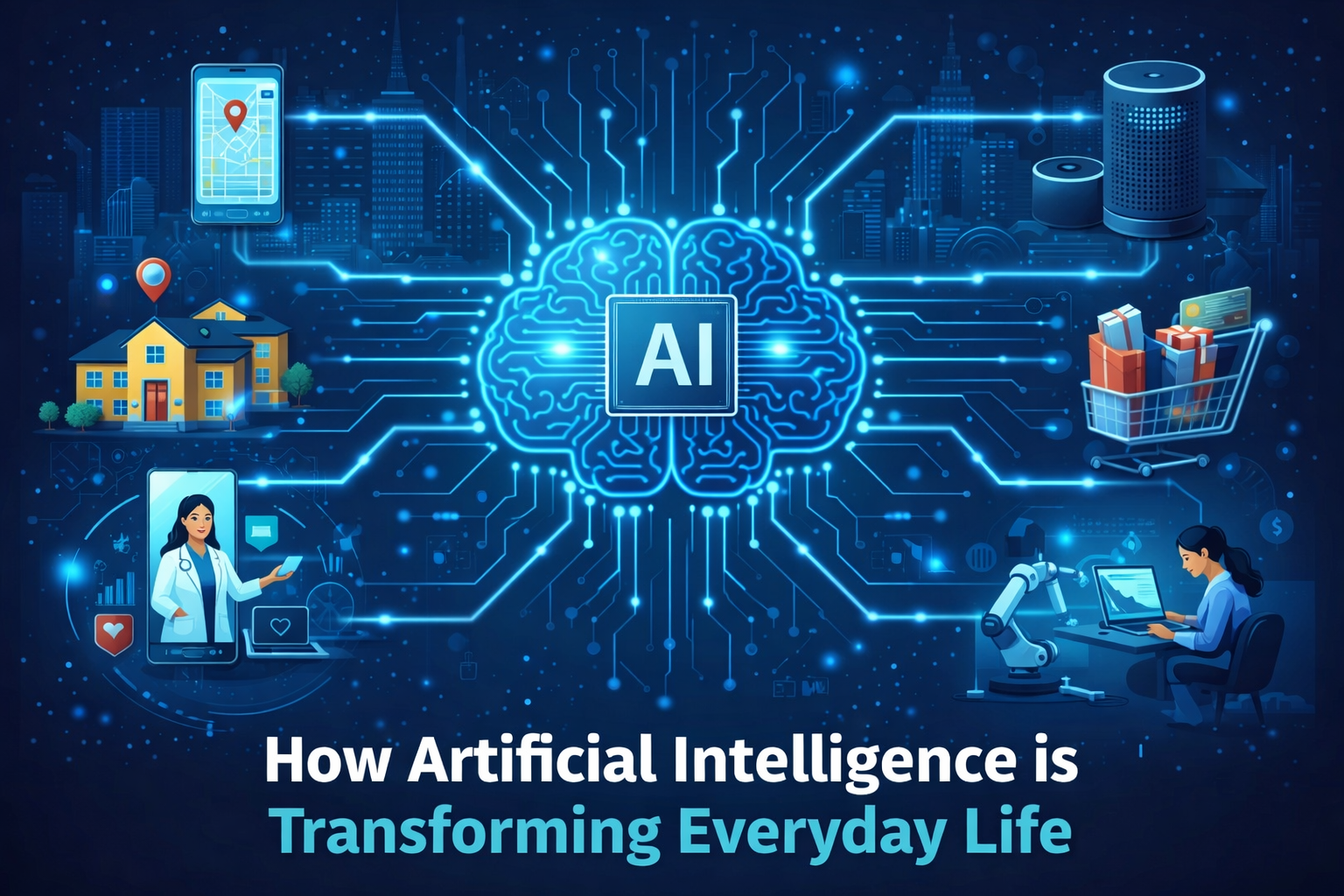
AI in Daily Life
AI is already a part of our daily life.
Examples:
- Google Maps traffic prediction
- YouTube video recommendations
- Online shopping suggestions
- Voice commands
If a person takes a wrong route without using Google Maps
- Let’s say 20 minutes extra travel per day.
- 20 minutes × 30 days = 600 minutes
- = 10 hours per month saved using AI navigation
That means 10 hours of time saved per month by AI.
AI has become a part of our daily life without us even realizing it. AI is working from morning alarm to night mobile lock.Smart home devices are also working on the basis of AI.Smart TV suggests your favorite programs.A smart fridge detects the contents inside and gives instructions.Smart watch analyzes your sleep pattern.These are improving our standard of living.
For example:
If you see a shoe online, ads for the same type of shoe will appear in the following days. This is because AI recognizes your interests.
Even the smart phone camera uses AI.
- Auto focus
- Face detection
- Night mode
- All these work based on AI.
In this way, our life has become easier and faster.
AI in Education
AI is revolutionizing the education sector.
By AI:
- Personalized learning
- Doubt solving instantly
- Smart practice tests
- Language translation
If a student studies with AI tools for 1 hour a day:
- 1 hour × 30 days = 30 hours learning/month
- 6 months → 180 hours
- 180 hours of focused learning means a complete skill can be learned.
It has become a big opportunity for rural students. World-class content is available if you have Smartphone Internet.
Even if good teachers are not available in rural areas, AI based apps are helping students.
By AI:
- Identify each student’s weak points
- Creating an individual lesson plan
- Analysis of Question Type in Exams
- It increases the self-confidence of the students.
Furthermore, English can be learned in a spoken manner through AI. Language barriers will be reduced.
AI in Healthcare
AI is revolutionizing the healthcare sector.
Uses of AI:
- Disease prediction
- Medical report analysis
- Online consultation
- Fitness tracking
Example:
If an AI diagnostic tool analyzes 1000 reports
Let’s say it takes 10 minutes/report to make a human.
1000 × 10 minutes = 10,000 minutes
= 166 hours
AI can do the same in minutes.
Because of:
- Early disease detection
- Treatment will be fast
- Medical cost will decrease
Even if doctors are not available in rural areas, AI-based mobile applications are providing basic health referrals.
For example:
- Heart rate monitoring
- Blood pressure tracking
- Diabetes Monitoring
AI collects data and provides early warning of danger.
This increases the chance of saving lives.
AI in Business & Jobs
AI has increased productivity but some traditional jobs are at risk.
Example:
- If an employee works 4 hours a day on data entry
- AI tool completes the same task in 30 minutes.
- 4 hours – 0.5 hour = 3.5 hours saved/day
- 3.5 × 25 working days = 87.5 hours/month productivity gain
- This is a big profit for business.
- But low-skill jobs are likely to decrease.
- That is why it is necessary to learn digital skills.
The use of AI in businesses is reducing costs and increasing profits.
For example:
- Customer support chat bots
- Stock Management
- Market trend predictions
But jobs are changing. Old ways are fading away.
So youth need to learn new skills:
- Data analysis
- Programming
- Digital marketing
These are the skills that will be needed in the future.
AI and Automation
Automation is reducing repetitive tasks.
In Factories:
- Robotic arms
- Quality inspection systems
- Packaging automation
- Work done by 100 workers in a factory
Let’s say AI automation will complete with 40 workers.
Cost saving: 60 workers × ₹15,000 salary
= ₹9,00,000 per month saving
This is a huge financial advantage for companies.
Automation increases the speed of production.
Errors will be reduced.
Quality improves.
But job opportunities change in society. Therefore government and organizations should undertake retraining programs.
As technology evolves, so must man.
AI in Finance & Digital Payments
AI in Banking:
- Fraud detection
- Credit score analysis
- Loan approval automation
Example:
A bank processes 500 loan applications per day
Manual verification takes 30 minutes/application.
500 × 30 = 15,000 minutes
= 250 hours
AI verification will complete it in few hours.AI enhances security in digital payments.
Analyzes every transaction and detects suspicious activity.
For example:
If a person normally transacts in Hyderabad, the AI will immediately alert if a transaction suddenly takes place abroad.
This can prevent fraud.
Risks & Challenges of AI
There is not only a positive side to AI.
Risks:
- Job displacement
- Data privacy issues
- Fake content (Deepfakes)
- Over dependency
- If completely depend on AI
There is a risk of decreasing human thinking skill.
Example:
- If 2 hours per day depend on AI
- 2 × 365 = 730 hours/year
- 730 hours means 30 days equivalent time.
Human self-thinking is likely to decrease.Fake videos and images created by AI can create misconceptions in the society.
There is a risk of personal information being misused.
Therefore:
- Strict laws are needed
- Data protection procedures are required
- Ethical guidelines are essential
- Responsible for technological development
Future of AI
AI in the Future:
- Self-driving vehicles
- Smart cities
- Advanced robotics
- AI-powered education systems
Productivity will increase with AI
There is risk if human skills are not upgraded.
AI will not replace —
AI has the potential to replace humans who cannot use it.
AI has the potential to completely change our lifestyle in the future.
Smart Cities:
- Traffic control
- Energy consumption optimization
- Water management
In Agriculture:
Crop health analysis
- Weather forecasts
- Increase yield
- AI can benefit society if used in the right direction.
But human values and morals should always come first
External Links
https://en.wikipedia.org/wiki/Artificial_intelligence
https://www.weforum.org/agenda/topics/artificial-intelligence/
https://www.ibm.com/topics/artificial-intelligence
7 Shocking Ways Modern Food Habits Are Changing Human Health
1 thought on “9 Powerful Ways Artificial Intelligence (AI) Is Transforming Human Life”