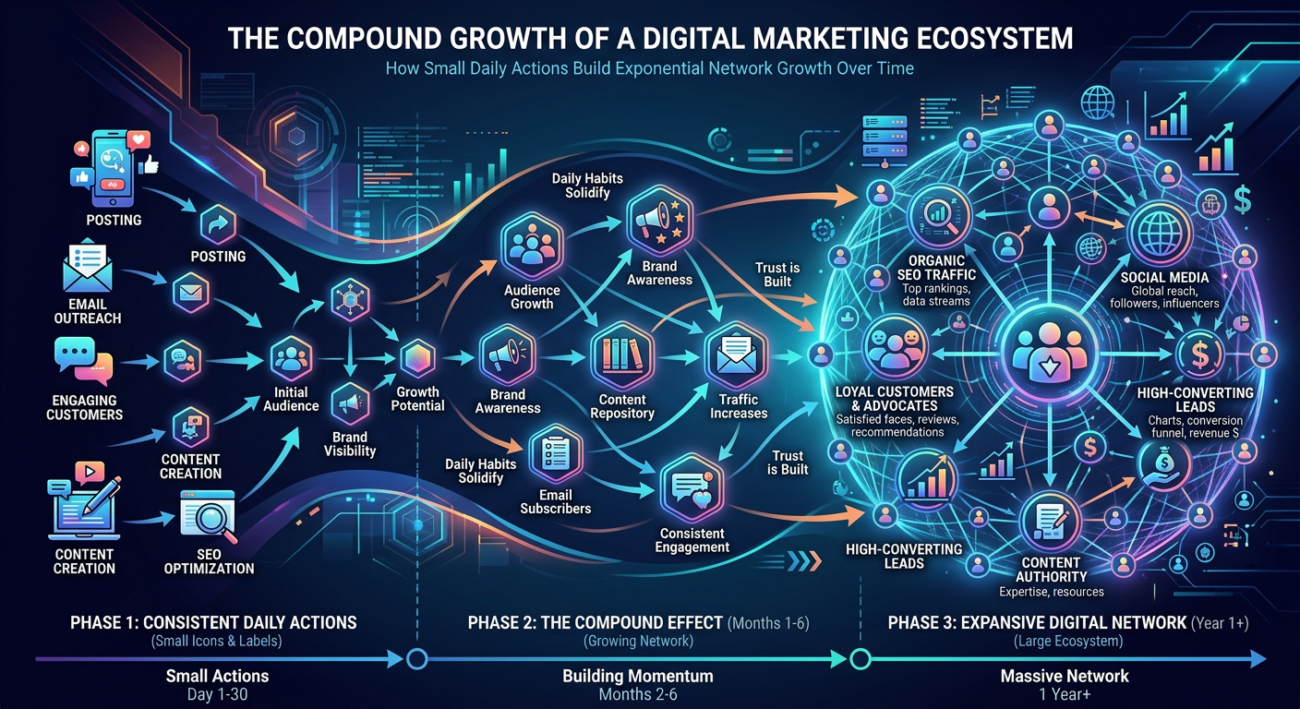
Marketing Growth – The Real Power Behind the Compound Effect
Many marketers or service providers ask a common question – “Why aren’t our efforts yielding immediate results?” They expect to see a huge change in the first month. Some stop within a few days. Others conclude that “marketing doesn’t work.”
But the truth is, marketing is like a seed. If you plant it today, it won’t grow into a tree tomorrow. It needs to be watered, nurtured, and given time. Similarly, even if small actions taken in marketing don’t yield big results right away, they can add up to a big impact over time. This process is called the “compound effect.”
The compound effect is when each small action adds up over time. For example, even if you achieve just 1% improvement per day, it can add up to a huge change by the end of the year. It may not be noticeable at first. But if you continue without stopping, the results will be amazing.
- The mistake many people make in marketing is that they only look at the result.
- They don’t look at the process.
- They just advertise one day and expect sales to increase immediately.
- But marketing is a process of building trust. It grows slowly.
- Only when trust grows will customers come back.
- Only when they come back will growth be sustainable.
In this article, we will delve deeper into how to understand marketing growth through the compounding effect, how to calculate it with numbers, and how to implement it in practical life.
What is the compounding effect? Its true meaning in marketing
The term compounding effect is very easy to understand. If you make a small improvement every day, it will give a huge result over time. It is like a tree growing from a seed.
How does this work in marketing? Let’s take an example. You are talking to your customers every day. Answering their questions. Improving the service a little. A small improvement every week. You may not see a big change in the first month. But after six months, a year, you will notice – the number of customers has increased steadily.
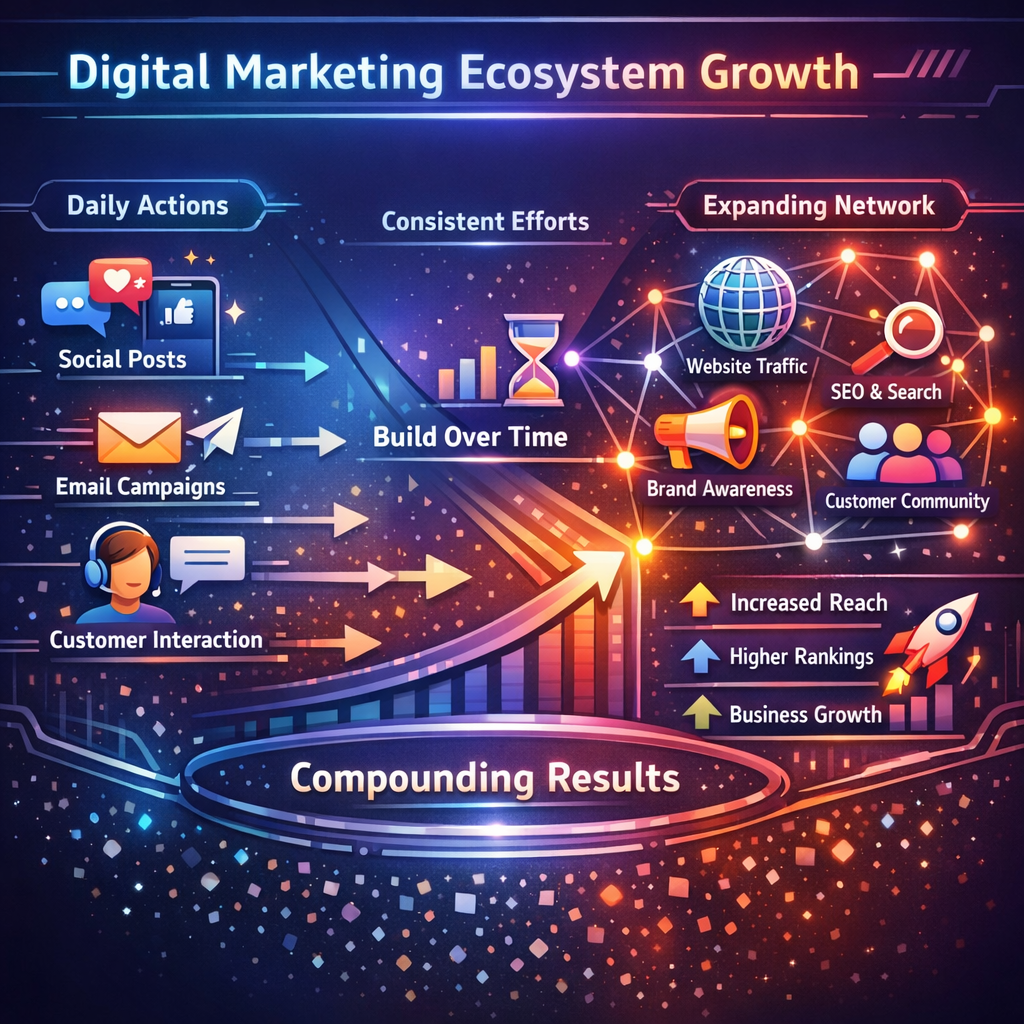
Let’s understand this with an analogy.
Comparison 1:
A 1% improvement per day is like going from 100 to 101. A small change. But if that same 1% improvement continues for 365 days, the result will increase by about 37 times (1.01^365 ≈ 37).
But if it decreases by 1% per day? 0.99^365 ≈ 0.03. That means you lose almost all of the first.
How does this apply to marketing? If you improve by 1% every day – message, service, response, trust – over time, you will see huge growth. But if you neglect it every day, even that will fall by the wayside.
Comparison 2:
A business is gaining 100 customers every month. Another business started with 50 and is growing by 10% every month.
The first business gains 1200 customers by the end of the year (100 x 12).
The second business starts with 50 and grows by 10% monthly to about 157 customers by the end of the year (50 x 1.1^12 ≈ 157).
Even if it seems small at first, if the growth rate is consistent, it will grow over time.
Marketing is not an event. It is a habit. Small actions – talking to the customer, improving service, maintaining quality – all of them together create a compound effect.
The main thing to remember is that in the first stage, the result is not visible. Many people stop at that stage. But real growth begins to appear after the third or fourth month. It is like a tree growing roots in the soil.
Understanding Marketing Growth with Numbers
Numbers always tell the truth. Our emotions sometimes deceive us. Even if it seems like “we are not growing”, the numbers say – there is growth, but it is slow.
Let’s do a little calculation.
Formula:
Future value = Present value x (1 + growth rate)^time
Example:
You currently have 200 loyal customers. What if you could grow 5% every month?
Future Value = 200 x (1.05)^12
1.05^12 ≈ 1.795
So by the end of the year
200 x 1.795 = 359 users (approx.)
It doesn’t seem like a sudden increase from 200 to 359. But with just 5% growth per month, that’s almost 159 more people.
Another example:
Let’s say you’re getting 2 new users every day.
60 people in the first month.
But what if they’re satisfied and each brings in 1 more person?
60 people x 1 = 60 new people
A total of 120 people.
This can be written in the following way:
Total = Current Users + (Current Users x Forecast Percentage)
These numbers are very important in marketing. Because growth isn’t a one-time hit. It’s a steady, growing wave.
First 100 → 105 → 110 → 116 → 122 → 128…
In this order, small increases are seen. But if you look at it after a year – the change is significant.
The compounding effect teaches us a big lesson:
“Don’t take small improvements for granted.”
Practical examples – Compounding effect in real life
Suppose a person named Ramu runs a small service center. Initially he had only 5 customers per day. He decided – to make 1 small improvement in the service every day.
First week – Respond quickly.
Second week – Speak politely.
Third week – Resolve complaints promptly.
Fourth week – Re-contact old customers.
In the first two months,There was no significant change in the first two months. But in the fourth month, 8 people a day. In the sixth month, 12 people. By the end of the year, 20 people.
This did not happen all at once. Each small action had an impact.
Another example:
An educational institution aims to achieve a 3% growth rate every month. Initially, 300 students.
3% growth means an additional 9 people per month.
By the end of the year:
300 x (1.03)^12 ≈ 427 people.
That is an increase of 127 people. This is not because of a big announcement. It is because of continuous effort.
The important thing here is – time.
The compound effect loves time. It does not work if you rush it.
Frequently Asked Questions (FAQ)
Question 1: Does the compounding effect give immediate results?
No. It works slowly. Even if you don’t see results in the first stage, if you continue without stopping, you will see a huge change over time.
Question 2: Do small improvements really make a big difference?
Yes. Statistics show that a 1% improvement per day can add up to 37 times by the end of the year.
Question 3: What aspects of marketing should be improved?
Service quality, response speed, customer relationships, trust building – all these are important aspects.
Question 4: How long does it take to see results?
Usually, a clear change starts to be seen after 3 to 6 months. But it depends on the sector.
Question 5: What should be the growth rate?
A small percentage is enough. Even 3% or 5% per month can give significant growth over time.
Conclusion
Marketing growth is not a race. It is a journey. If you rush this journey, you will be disappointed. But with patience, consistency, and small improvements – the compounding effect will give you amazing results.
You may not see the change in the first few days. That is natural. When the seed is in the ground, we cannot see the tree. But the roots keep growing inside. Similarly, the hard work in marketing builds trust inside.
The numbers tell us – even small percentages of growth will give big results over time. So don’t be disappointed with the results of one day. Look at the journey of a year.
Real success comes with patience. Make a small improvement every day. Make a small improvement every week. Aim for a steady growth every month.
The compounding effect works silently. But once it starts working, it is hard to stop. Patience is your friend. Consistency is your strength. A clear direction is your guide.
External Links
https://marketingexperiments.com/a-b-testing/the-compounding-effect-of-micro-gains-tested?utm

3 thoughts on “Marketing Growth Explained with Compound Effect”