Introduction
When most people hear the word “marketing,” the first thing that comes to mind are advertisements, posters, videos, and social media campaigns. We have a strong sense that sales will increase if they are seen more.
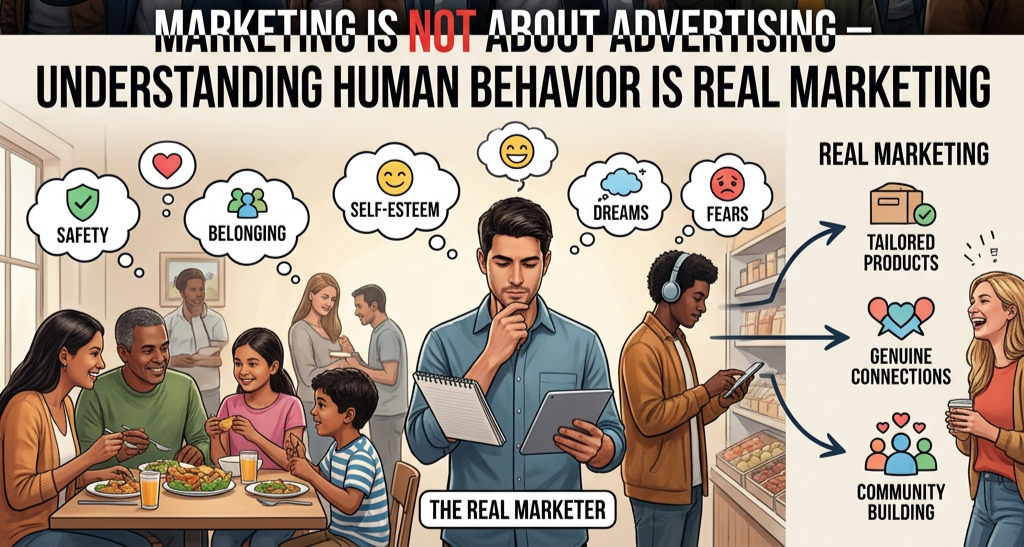
But in reality, marketing is not a game of visible advertising. It is a process of understanding people’s thoughts, their needs, fears, hopes, and decisions.
Before a person buys something, many questions run through his mind.
- “Do I need this?”,
- “Will this really be useful?”,
- “Will I lose money if I buy this?”,
- “What will others think?”
All these questions influence his decision. Marketing means answering these questions in advance.
Advertising is just noise. But marketing is conversation. Advertising is just showing. But marketing is listening. The reason why many businesses fail is not the quality of their product. The main reason is that they do not understand people’s minds.
For example,
- A small shop puts up posters and advertises on a daily basis.
- But customers are not coming.
- Why? People’s trust is more important than the price of the goods they sell.
- Once a customer is trusted, he will come back.
- This is not because of advertising, but because of experience.
If you want to learn more about human behavior, you can read this article:
https://www.simplypsychology.org/what-is-psychology.html
Marketing is a psychological journey. How does a person think? How does he react in which situation? How do his needs change? What does he value? Only by knowing all this is true marketing possible.
Many people think that “more advertising is enough”. But before advertising, one question should be asked — “Who are we telling? Why are we telling? What do they really want?” If these questions are not clear, no matter how much advertising is done, it will not be useful.
In this article, let us take a deeper look at why marketing should be more than advertising, why it is important to understand human behavior, what are the main problems that stand in the way, and how to solve them.
Don’t Having Clear Direction To achieve
If a boat does not have a direction, it will not reach its destination no matter how fast it sails in the ocean. This is the situation of many businesses. What do they want to achieve? Who do you want to reach? What is their specialty? They move forward without answering the questions.
Lack of direction means lack of clarity of goal. “Sales should increase” is not a goal. “1000 new users should join this year” is a goal. Only with a clear goal can the right path be found.
Many times a business looks at others and imitates them. If they are on social media, we should be too. If they make videos, we should do the same. But this is not the right direction. Our situation, our customers, our product specialty are different. The direction should be based on our needs, not on others.
- Another big disadvantage of lack of direction is that we change our decisions after every small result.
- If we don’t see results in a week, we change our strategy,
- If we don’t see a big change in a month,
- We try a completely new method — these destroy stability.
How can a farmer grow a plant if he digs the ground two days after sowing a seed? Similarly, patience is needed in marketing. If the direction is clear, we don’t change our path even if we don’t see results for a while. Because we know — this is a long-term journey.
A business with direction examines every decision with one question:
- Does this serve our main goal?
- This question is like a compass that guides us.
Problems caused by lack of direction:
1. The message keeps changing
2. Confusion among customers
3. Time and money are wasted
4. There is no clarity in the team
Let’s take a small example. A training center first starts courses for children. After a few days, it offers courses for youth. Then special training for employees. The goal changes every month. In the end, they don’t even know who they are working for. The result — no one is completely convinced.
A business with direction thinks: “Our main goal is to provide affordable education to students in rural areas.” Every decision made with this clarity is in the same direction. Trust increases among consumers.
Comparison
When there is direction
- The goal is clear
- The message is the same
- Consumers gain trust
- Long-term growth is possible
When there is no direction
- The goal is confusing
- The message changes
- Consumers get confused
- Only temporary efforts
Direction is the first step in marketing. If we don’t know where we want to go, no matter how hard we try, we won’t see results.
Having Less Targeting Audience
Not every product is for everyone. But many people try to reach everyone. This is a big mistake. If you speak without a clear category, no one will listen.
A small example: What if the message you give to a 60-year-old person is the same as the message you give to a 20-year-old? Their needs, thoughts, and priorities are different. That’s why target audience clarity is so important.
When determining your target audience, ask these questions:
* How old are they?
* Where do they live?
* What is their main problem?
* What do they value most?
Only when these questions are answered can the right message be formulated.
Real Life Example
Clear Target Audience
- Message goes straight to the heart
- Solution tailored to needs
- Confidence increases
Unclear Target Audience
- Message has little impact
- Generalized language
- Interest decreases
If the target audience is not clear, marketing becomes mere speculation.
Wrong Message Problem
Many times the problem is not in the product, but in the messageThe main reason for the wrong message — we think only from our perspective. “We have worked hard to make our product”, “We have a lot of experience” — all these are great things in our eyes. But the only thing that matters to the consumer is: “How can this benefit me?”
For example, if an educational institution says “We have 15 years of experience”, it is just information. But if it says “80% of our students have got good opportunities”, it is effective. Because it shows the result.
The message should be clear, simple, and reflect the consumer’s problem. Complex words and incomprehensible details add to the confusion. The right message is one that leaves the listener with the feeling “This is for me”.
External Links
https://www.investopedia.com/terms/m/marketsegmentation.asp
https://hbr.org/2012/10/data-scientist-the-sexiest-job-of-the-21st-century

3 thoughts on “Marketing is not about 1 advertising – understanding human behavior is real marketing”