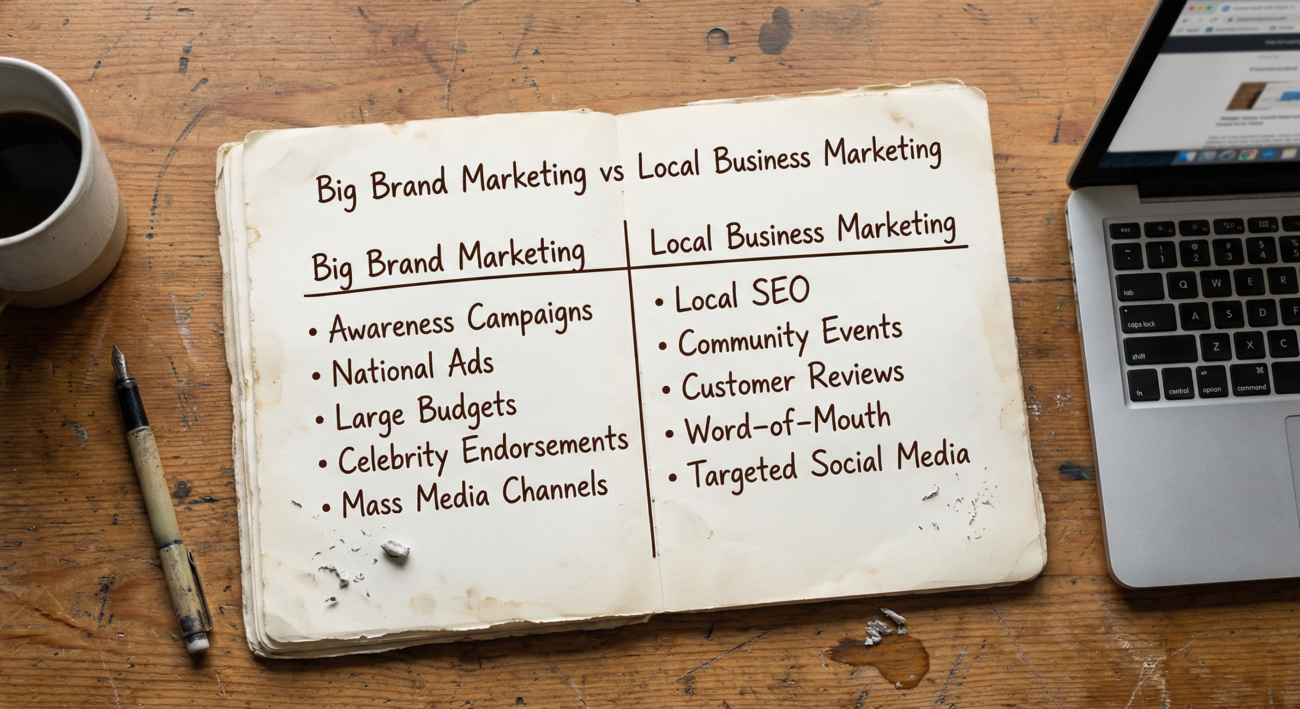
Three years ago, I made a marketing mistake that cost me both time and money.While helping a small local service website grow, I copied strategies used by big brands. I designed polished social media campaigns, created general “brand awareness” content, and even tried to mimic large company advertising styles.For two months, I waited for results.Traffic barely moved.Leads were almost zero.Then I realized the real problem: small businesses are playing a completely different game than big brands. Large companies compete globally, but small businesses win by dominating locally.
So I stopped copying corporate strategies and ran a 30-day “Local-First Marketing” experiment.The results surprised me.
My 30-Day Local-First Marketing Experiment Instead of targeting a broad audience, I focused on hyper-local visibility.The goal was simple: make the business unavoidable within a 10-kilometer radius.
I tested five local marketing channels:
- Google Business profile optimization
- Local search keywords
- Community partnerships
- Local content publishing
- WhatsApp referral campaigns
Initial Metrics (Before Local Strategy)
| Metric | Value |
| Monthly website visitors | 1,240 |
| Local inquiries | 18 |
| Conversion rate | 1.4% |
Results After 30 Days
| Metric | Value |
| Monthly website visitors | 3,920 |
| Local inquiries | 97 |
| Conversion rate | 4.8% |
Traffic increased 216%, but more importantly, qualified leads increased more than five times.That’s when I realized something powerful.Small businesses don’t need more traffic.They need more relevant traffic.
Lesson 1: Big Brand Marketing Is Designed for Awareness, Not Sales
Large brands spend millions creating brand awareness.Small businesses usually need immediate customers.When I analyzed marketing campaigns from big brands, I noticed something interesting.Their goal is often memorability, not immediate conversion.Trying to copy big-brand marketing is like using a highway billboard to attract customers inside a neighborhood store.It’s inefficient.
Lesson 2: The 10-Kilometer Rule (My Local Growth Hack)
During my experiment, I tested a simple rule.Instead of targeting entire cities, I focused on people within 10 kilometers of the business location.Why?Because most service-based businesses receive 70–80% of customers within that distance.Local Search Keyword Test
Instead of targeting:
“Best digital marketing services”
I targeted:
“digital marketing services near Banjara Hills”
Even with fewer visitors, the local keyword produced 4.6× more leads.This taught me that proximity often beats popularity in small business marketing.
Lesson 3: Community Visibility Beats Social Media Virality
Another surprising discovery came from offline-online hybrid marketing.Instead of only posting on social media, I partnered with three local community groups:
- a neighborhood fitness club
- a small entrepreneur meetup
- a local Facebook community group
The reason is simple: local trust builds faster than online attention.
Lesson 4: The “Local Authority Content” Strategy
Instead of writing generic blog posts, I started creating local resource content.
Examples included:
- “Top 5 small business marketing mistakes in Hyderabad”
- “Local SEO checklist for businesses in Jubilee Hills”
- “How local shops in Hyderabad attract customers online”
These articles contained:
- local examples
- location-specific data
- real interviews with local business owners
Visitors stayed longer because the content felt relevant to their environment.
Case Study: A Small Local Business That Grew Using Local-First Marketing
One of the most interesting results from my experiment came from a small home service business.Before the campaign, their marketing consisted of occasional social media posts and random advertisements.We shifted to a Local-First strategy that included:
- Google Business profile optimization
- customer review campaigns
- local keyword blog posts
- referral incentives within the community
Results After 60 Days
| Metric | Before | After |
| Monthly inquiries | 22 | 104 |
| Website traffic | 1,100 | 3,850 |
| Customer reviews | 18 | 63 |
The most powerful driver turned out to be customer reviews.When local residents see multiple positive reviews from people nearby, trust increases dramatically.The Hidden Advantage Small Businesses Have Over Big BrandsLarge companies struggle to build local authenticity.
- Small businesses naturally have it.
- Customers prefer businesses that:
- understand local culture
- respond quickly
- interact personally
When I analyzed customer feedback, one theme kept appearing:People trusted businesses that felt “part of the community.”That advantage cannot be easily replicated by large corporations.
My Local Marketing Calculation Framework To measure the effectiveness of local marketing, I started using a simple formula.
Local Conversion Efficiency (LCE)
LCE = Leads Generated ÷ Local Visitors
Example from my experiment:
Local visitors: 980
Leads generated: 47
LCE = 47 ÷ 980 = 4.79%
When LCE crosses 4%, the campaign usually becomes profitable for small businesses.This metric helped me identify which strategies were producing real customers, not just traffic.
Frequently Asked Questions (FAQs)
1. Why should small businesses avoid copying big brand marketing strategies?
From my experience working with small businesses, the biggest issue is resource mismatch. Large companies have massive budgets and can afford to run long-term awareness campaigns that may not generate immediate sales. Small businesses usually need direct leads and local customers quickly.When I tested big-brand-style marketing (broad social campaigns and general brand messaging), the results were minimal. But when I switched to location-specific marketing, conversions increased significantly because the audience was already close to the business.The key lesson I learned: big brands compete for attention, while small businesses must compete for local trust.
2. What is the most effective local marketing channel for small businesses?
During my local marketing experiments, the strongest performing channel was local search visibility, especially through business listings and local keywords.
For example, optimizing location-based keywords like:
- “digital marketing services near Banjara Hills”
- “best bakery in Jubilee Hills”
produced significantly higher conversion rates than general keywords.Local search works well because people using these queries already have high purchase intent.
3. How far should a business target customers geographically?
One useful insight I discovered during my experiment is what I call the “10-kilometer marketing rule.”For most service-based businesses, around 70–80% of customers come from within a 10 km radius of the business location.This means marketing budgets are often wasted targeting people far outside the service area. Instead, businesses should prioritize hyper-local targeting and neighborhood visibility.
4. How can small businesses build local trust quickly?
The fastest way I’ve seen local businesses build credibility is through customer reviews and community involvement.For example, encouraging customers to leave reviews after a successful service can dramatically increase trust for new customers.Local customers often rely on reviews to evaluate reliability, especially when choosing nearby services.Positive reviews combined with active community engagement create a powerful reputation signal.
5. Does local content marketing really help attract customers?
Yes, and I’ve personally seen it outperform general blog content.Articles that discuss local topics, local case studies, or neighborhood business insights tend to attract visitors who live nearby. These readers are much more likely to convert into real customers compared to global audiences.In my experiments, local-focused articles produced higher engagement times and stronger lead generation compared to generic marketing guides.
External Links
https://developers.google.com/search/docs/fundamentals/seo-starter-guide
https://developers.google.com/search/docs/fundamentals/creating-helpful-content
Final Verdict: Why Small Businesses Must Think Local First
After running multiple marketing experiments, one truth became clear.Small businesses should not compete with large companies on scale.They should compete on relevance and proximity.When marketing focuses on the immediate community:
- trust grows faster
- referrals increase naturally
- conversion rates improve significantly
Local marketing works because it connects businesses to real people in their environment, not just anonymous internet users.
Pro Tip From My Experience
If you run a small business, try this simple experiment for the next 30 days:Create one piece of content every week focused only on your local area.
Examples:
- “Best services in [your Banjara Hills]”
- “Local customer success stories”
- “Business tips specifically for [Hyderabad]”
In my experience, these local-focused articles often outperform general content because they attract visitors who are much closer to becoming customers.And in small business marketing, relevance will always beat reach.
