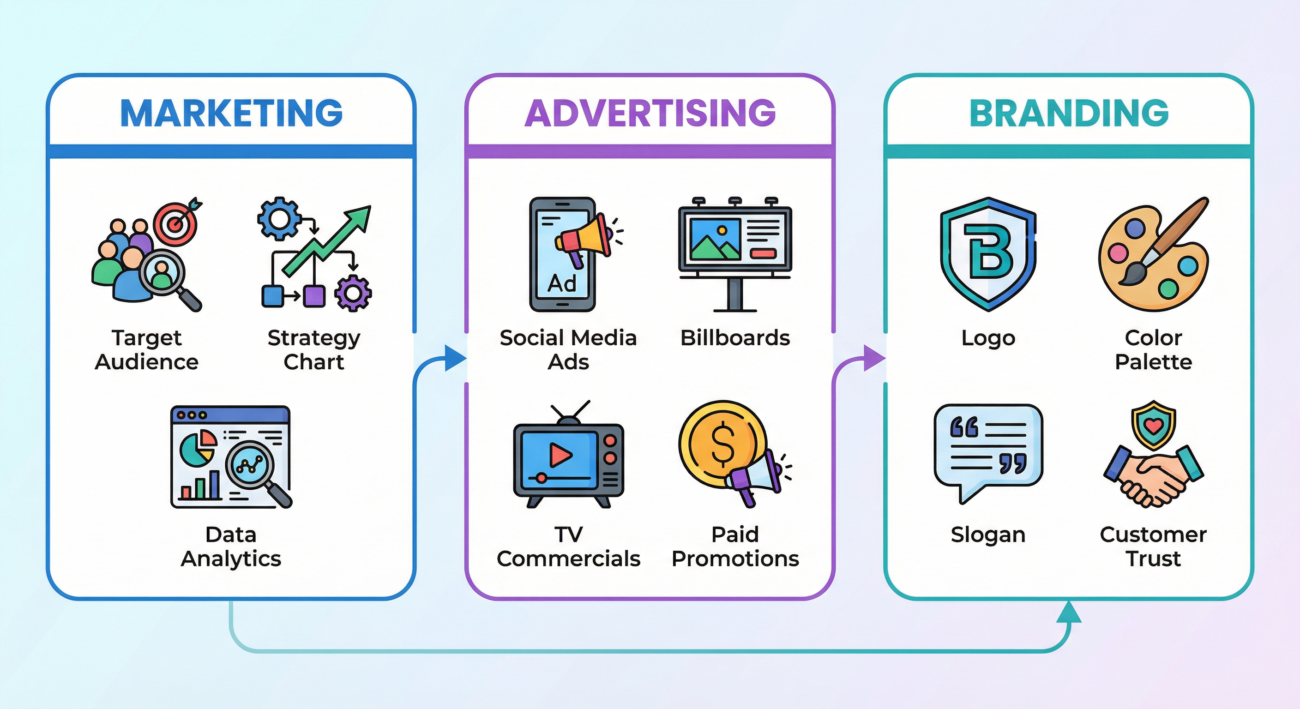
Many people use the terms marketing, advertising, and branding interchangeably, but in reality, they represent distinct elements of a business strategy. Understanding the difference between these three components is essential for entrepreneurs, marketers, and small business owners who want to create effective strategies, attract loyal customers, and build a strong market presence.
In simple terms:
– Marketing is the overall strategy to attract, engage, and retain customers.
– Advertising is a paid tool used to promote products, services, or events to a larger audience.
– Branding is the identity, perception, and emotional connection your business creates with its audience.
When combined effectively, marketing, advertising, and branding create a powerful synergy that helps businesses grow sustainably over time, reduce customer acquisition costs, and foster trust and loyalty among their target audience.
Understanding Marketing
Marketing is the comprehensive process of understanding your customers and delivering value to them. It encompasses all activities a business undertakes to communicate benefits, solve customer problems, attract attention, and maintain long-term relationships.
Key marketing activities include:
– Market research to identify customer needs, preferences, and pain points.
– Product or service development based on customer insights.
– Pricing strategy that aligns with perceived value and market standards.
– Customer communication, engagement, and relationship-building through multiple channels.
– Performance tracking and continuous optimization to improve results over time.
Marketing sets the foundation for every business campaign. It ensures that a company knows its audience, understands their behavior, and creates products or services that address real problems. A strong marketing strategy helps reduce wasted efforts and ensures that advertising and branding efforts are focused and effective.
For beginners who want to learn more about marketing, check out our guide on
https://worldlune.com/what-is-marketing-and-why-every-business-needs-it
What Is Marketing and Why Every Business Needs It.
Marketing is not just about selling a product; it’s about creating meaningful experiences that connect with the customer at multiple touchpoints. For example, businesses can use content marketing, email campaigns, social media posts, and webinars to educate their audience and build trust before asking for a purchase.
Understanding Advertising
Advertising is a specific subset of marketing that focuses on promoting products, services, or events to a larger audience, typically through paid channels. While marketing defines the strategy, advertising executes the communication.
Common advertising forms include:
– Social media ads on platforms like Facebook, Instagram, LinkedIn, or X.
– Search engine ads using Google Ads or Bing Ads.
– Sponsored content on blogs, news sites, and influencers’ channels.
– Traditional advertising like TV commercials, radio spots, print ads, and billboards.
Example:
If a company launches a new smartphone, social media campaigns, search engine promotions, and billboard displays form the advertising strategy. Meanwhile, market research, pricing decisions, and target audience selection remain part of marketing.
Advertising is effective for generating immediate awareness, promoting limited-time offers, or attracting new customers. However, its success depends heavily on a strong marketing foundation. Ads without strategic direction often fail to reach the right audience or convert viewers into loyal customers.
Understanding Branding
Branding focuses on shaping how people perceive your business. It is the process of creating a consistent, recognizable identity that builds trust and emotional connections with your audience.
– Logo, colors, fonts, and other visual elements.
– Company name, slogan, and voice of communication.
– Reputation and customer experience.
– Consistency across all marketing channels and touchpoints.
Strong branding ensures that customers recognize your business instantly and associate it with quality, reliability, and positive emotions. Branding affects customer loyalty: when people trust your brand and enjoy positive experiences, they are more likely to return and recommend your business to others.
For more on creating lasting customer trust, see
https://worldluen.com/audience-trust-the-hidden-currency-in-marketing
Audience Trust – The Hidden Currency in Marketing.
Branding goes beyond visuals. It includes every interaction a customer has with your company — from the packaging of a product to customer service and even the tone of your social media posts. Businesses with strong branding create a competitive advantage that is difficult for competitors to replicate.
How Marketing, Advertising, and Branding Work Together
While marketing, advertising, and branding are distinct, their synergy creates stronger results:
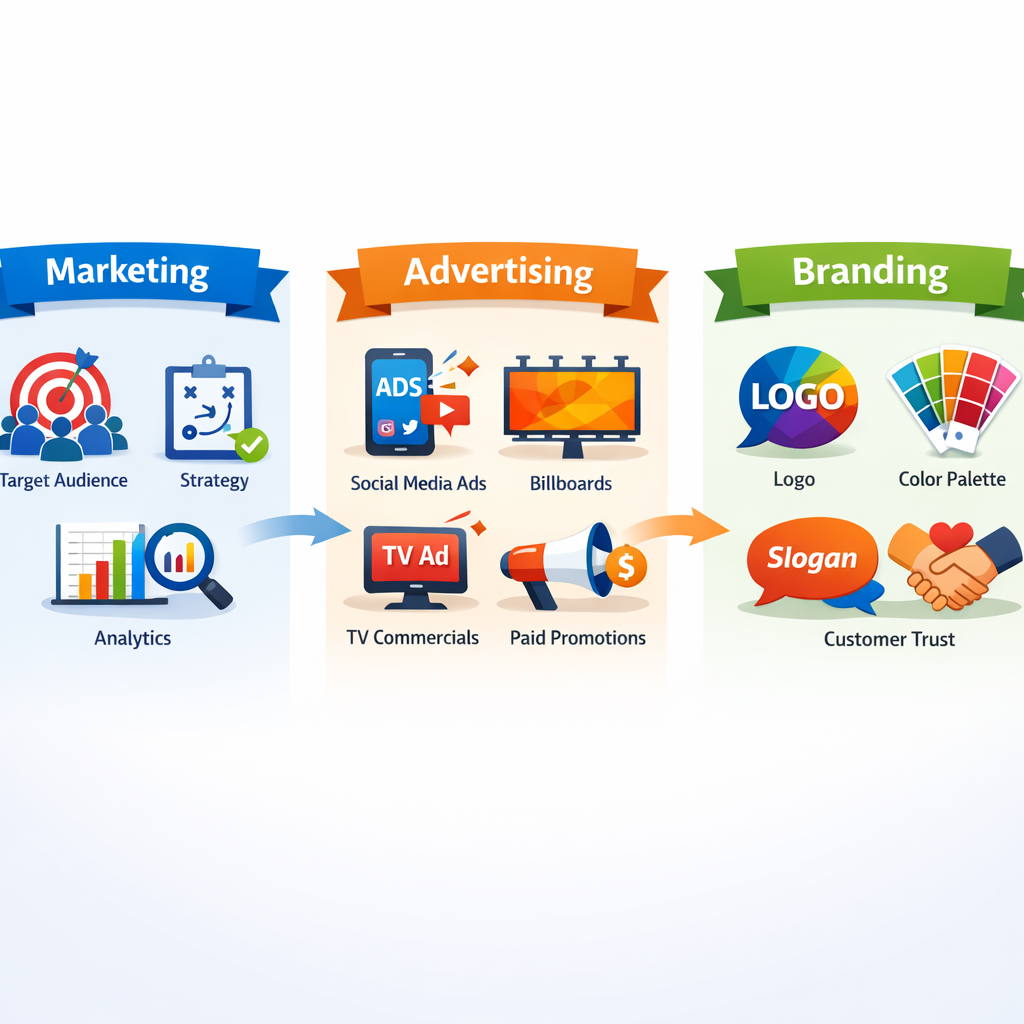
– Marketing provides the overarching strategy, identifying the audience, understanding customer needs, and designing the right solutions.
– Advertising communicates the message quickly and efficiently to a larger audience, generating awareness and interest.
– Branding shapes customer perceptions, builds loyalty, and ensures recognition across all interactions.
Example:
Imagine a small clothing brand launching a new line:
– Marketing identifies the target audience, designs the products, and sets competitive pricing.
– Advertising runs social media campaigns, sponsored posts, and influencer collaborations to attract attention.
– Branding ensures a consistent identity through a memorable logo, signature colors, and a tone that aligns with customer values.
All three elements work together to create long-term growth. Without marketing, advertising may miss the right audience. Without branding, advertising may generate short-term attention but fail to build lasting customer relationships.
Common Misunderstandings
– Advertising alone cannot replace a solid marketing strategy. It generates attention but not long-term results.
– Branding is more than just a logo. It includes every perception a customer forms about your business.
– Businesses succeed by investing in all three areas, not just one.
Frequently Asked Questions
What is the main difference between marketing and advertising?
– Marketing is the strategy to understand, attract, and retain customers.
– Advertising is a paid effort to communicate and promote specific products or services.
Is branding part of marketing?
– Yes, branding is a key component because it shapes perception, builds trust, and supports long-term customer relationships.
Can a business succeed without advertising?
– Some businesses grow organically, but advertising accelerates growth by reaching a larger audience quickly.
Why is branding important for long-term success?
– Branding builds recognition, fosters trust, and encourages repeat business and referrals.
Suggested Visuals for Engagement:
– Infographic comparing Marketing vs Advertising vs Branding.
– Example of a branded logo and color palette.
– Diagram of a marketing funnel showing how advertising and branding fit within marketing strategy.
Conclusion
Marketing, advertising, and branding serve unique but complementary purposes. Marketing provides strategic direction, advertising delivers messages to the audience, and branding builds recognition, trust, and emotional connection. Businesses that understand and implement all three elements effectively can create stronger customer relationships, improve conversion rates, and sustain long-term growth.
By integrating these three aspects, even small businesses can compete with larger competitors, build loyal audiences, and achieve measurable results. Always ensure consistency across all campaigns, monitor performance, and refine your strategy based on real-world data.
Call to Action:
Learn more about creating effective marketing campaigns and building audience trust by exploring our other guides:
https://worldlune.com/what-is-marketing-and-why-every-business-needs-it
https://www.ama.org/the-definition-of-marketing/
https://www.investopedia.com/terms/m/marketing.asp

One thought on “The Difference Between Marketing, Advertising, and Branding”