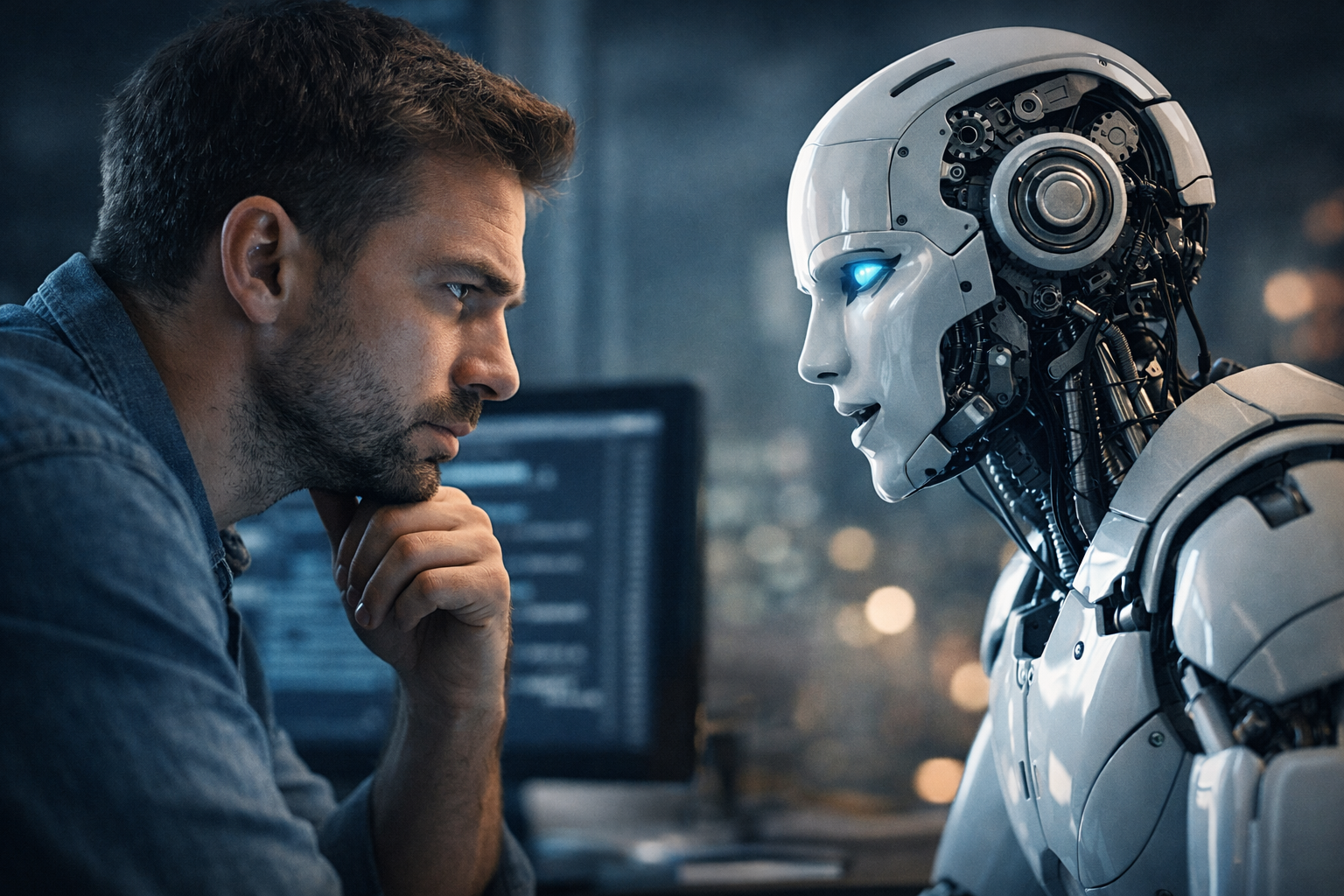
From Human Trust to Technology Trust
In earlier generations people lived by trusting each other. Borrowing, trading and verbal agreements are common in villages. Keeping one’s name, family honor, word – these are the foundations of faith. But even in that system there was danger.
If a person borrows ₹10,000 and does not return it, it is a total loss. There was no written record. If 2 out of 10 cheat:
10,000 × 2 = ₹20,000 loss
That is, faith was based on emotions.
Now the situation has changed. Bank transactions, digital records, contracts – all these are done on the basis of machines. An SMS will be sent as soon as a transaction is done. Every transaction has digital evidence.
Human memory is limited. But machine memory can store millions of records. That’s why trust in today’s times has shifted from emotions to data.
Accuracy and Speed: Why Machines Win
It takes time for man to calculate. Suppose a shop owner has to do 200 bills per day. If each bill takes 3 minutes:
200 × 3 = 600 minutes
600 ÷ 60 = 10 hours
That means the whole time of a day goes to calculations.
But if the same is done through billing software, a single bill can be completed in 20 seconds.
200 × 20 seconds = 4000 seconds
4000 ÷ 60 = 66 minutes ≈ 1 hour
That means saving 9 hours of time per day.
Machines work without emotion, without fatigue. Chances of making mistakes are less. Once the system is set, it gives the same result every time.
Because of this accuracy and speed people began to trust machines more and more.The financial gain from accuracy is also huge. Suppose an accountant makes 5 minor accounting mistakes in a month. If the average loss is ₹2,000 per mistake:
5 × 2,000 = ₹10,000 loss
For the year:
10,000 × 12 = ₹1,20,000
But let’s say these mistakes can be reduced by 90% if automated software is used. That means saving 90% of ₹1,20,000:
1,20,000 × 90% = ₹1,08,000 saving
This is a huge benefit for even a small business. This is why machine accuracy has become critical in business decisions.
Daily Life Decisions Powered by Machines
Machines play a role in every decision these days.
For example: Suppose traveling without using maps takes 15 minutes extra per day.
15 minutes × 30 days = 450 minutes
450 ÷ 60 = 7.5 hours
That means 7.5 hours saved per month.
Buying a product by looking at online reviews helps us avoid buying the wrong product. If you buy an item worth ₹5,000 by mistake once, it is a loss. But if you look at the ratings and take the right one, that loss will be avoided.
Digital payments have reduced the time spent in bank queues. If it takes 1 hour to go to the bank once, 4 times a month is 4 hours saved.
Machines make decisions based on data. That is why people trust machines in their daily life.One more practical example — health tracking apps. Suppose a person aims to walk 8,000 steps a day. Without the app he would likely only walk 5,000 steps on average.
Less than 3,000 steps per day.
Per month: 3,000 × 30 = 90,000 feet less
Assuming that an average of 1,000 steps burns ≈ 40 calories:
90 × 40 = 3,600 calories burned less
This means that the help of the app also has health benefits. In this way machines are streamlining our daily life style.
Emotional Gap: Why People Prefer Machines
Humans are subject to emotions. Anger, jealousy, fear – these influence decisions. Two people can give different answers to the same question.
But machine gives same data every time.
If a person asks 3 people for investment advice, 3 different opinions will come out. This can be confusing.
But data analysis software shows market statistics for last 5 years.
For example an investment of ₹50,000. If the growth is 10% per annum:
50,000 × 10% = ₹5,000
A profit of around ₹25,000 in 5 years (as per normal calculation)
Seeing such clear statistics gives people a sense of security.
That is why machines based on calculations and data are trusted more than emotions.Another reason — machines are not biased. In an interview a man may be influenced by the personal opinion of the interviewer. But the automated screening system only selects based on qualifications, skills, marks.
For example suppose there are 1,000 applications. If a man takes 5 minutes to examine a single application:
1,000 × 5 = 5,000 minutes
= 83 hours
But the software does the same thing and filters in a few minutes.
It not only provides time but also a fair selection process. That is why people are increasing their trust in machines.
Risks of Blind Trust in Machines
Total reliance on machines is also dangerous.
What if wrong data is given?
Making a decision based on wrong information?
For example, if a navigation app shows the wrong direction, let’s say we go 20 kilometers extra.
20 km × ₹5 (fuel cost per km) = ₹100 loss
If this happens 5 times in a month:
₹100 × 5 = ₹500
For the year:
₹500 × 12 = ₹6,000
That means if the machine goes wrong there is also financial loss.
Machines are not responsible. We need to examine the information they provide.
Hence the correct way is to —
Human intelligence must work together with the speed of machines.
Only then is a secure, efficient future possible.One more risk — data privacy. A leak of an individual’s personal information can result in financial and personal loss.
For example if a fraudulent transaction of ₹25,000 is made, the total loss is if it is not detected immediately.
If 1,000 people in a city are cheated like this:
1,000 × 25,000 = ₹2,50,00,000
This is a huge loss.
That’s why precautions like cyber security, password protection, two-factor authentication should be taken while trusting machines.Machines are only assistants — humans are the decision makers.
Conclusion: The Future of Trust in a Digital World
Faith has completely changed in today’s world. Once the word of man, family honor, and personal relationships were the foundation of trust — now data, records, and digital evidence have taken that place. A system based on emotions gradually became a system based on calculations, algorithms and software.
The speed, accuracy, storage capacity of machines — these surpass the capabilities of humans. A man can work only 8–10 hours a day. But machines work 24 hours a day without fatigue. If a company makes 1,000 transactions per day, and each transaction takes 2 minutes:
1,000 × 2 = 2,000 minutes
= 33 hours
That means at least 4–5 people are needed to do it with humans. But an automated system completes this task through a single platform. That’s why businesses rely heavily on machines.
However, complete reliance on machines is also risky. Man should think whether the information given by the machine is correct. A machine makes quick calculations but does not make moral decisions. Man is responsible.
So the right way in future is to —
Speed of human mind machines = safe and efficient society
External Links
https://en.wikipedia.org/wiki/Trust_in_technology
https://www.pewresearch.org/internet/
https://hbr.org/2019/01/trust-in-the-age-of-ai
7 Powerful Ways Artificial Intelligence Is Transforming Everyday Life
1 thought on “5 Powerful Shifts: Why Humans Trust Machines More Than Humans Today”