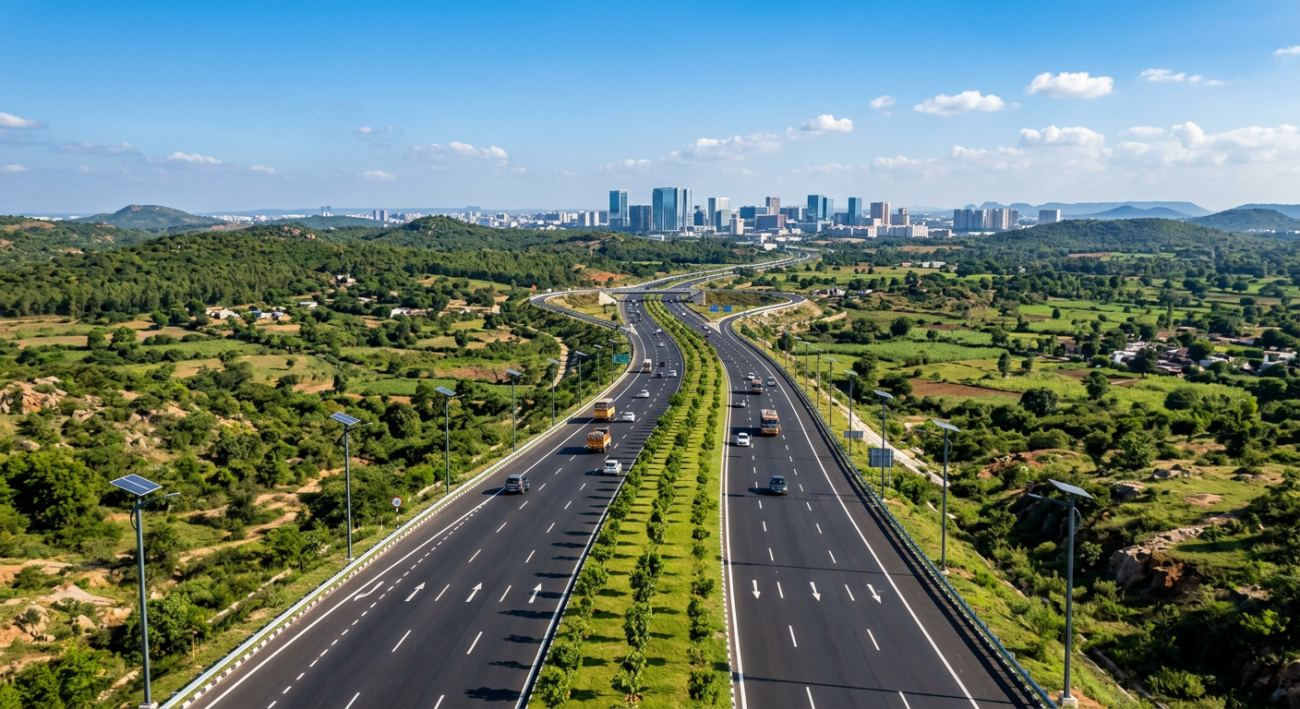
NHAI Wins ₹1,068.3 Cr Project: The Ultimate Guide to the Hyderabad-Bangalore Fast-Track Route
In a landmark move for South Indian infrastructure, the National Highways Authority of India (NHAI) has officially awarded a massive ₹1,068.3 Crore contract to revolutionize the Hyderabad-Bangalore transit corridor. This project isn’t just about laying tarmac; it’s a strategic initiative designed to synchronize the economic engines of Telangana, Andhra Pradesh, and Karnataka. As the “Silicon Valley of India” (Bangalore) and the “Genome Valley” (Hyderabad) continue to grow, this fast-track route acts as the digital and physical backbone for the next decade of Indian commerce.
Project Overview: More Than Just a Highway
The current NH-44, while functional, has long been plagued by local traffic bottlenecks, town-center congestion, and varying road quality. The new investment targets specific high-density sections to create a “Super Corridor.” By bypassing congested urban pockets and implementing access-controlled infrastructure, the NHAI aims to bring the travel time between these two capitals down to a staggering 4.5 to 5 hours.
| Metric | Existing NH-44 Route | New Fast-Track Project | Projected Impact | Technology Status |
|---|---|---|---|---|
| Avg. Travel Time | 8 – 10 Hours | ~5 Hours | 45% Time Saving | Live Traffic Monitoring |
| Design Speed | 80 km/h | 120 km/h | Higher Freight Efficiency | Speed Regulation AI |
| Road Configuration | 4-Lane Standard | 6-Lane Access Controlled | Lower Congestion | Smart Lane Management |
| Safety Grade | Moderate (Local Incursions) | High (Fenced/Bypassed) | 75% Accident Reduction | Automated Incident Detection |
| Toll System | Plaza-Based FASTag | Barrier-less GNSS | Zero Wait Time | Satellite-Based Tolling |
10-Point Detailed Analysis: Why This ₹1,068.3 Cr Investment Matters
1. Decoupling Local and Express Traffic
One of the primary reasons for the current 9-hour journey is the mix of local tractors, motorcycles, and long-haul trucks. The new project segment focuses on grade-separation, ensuring that through-traffic never interacts with local town traffic, maintaining a constant velocity v for the entire journey.
2. Strategic Economic Corridors
The corridor will pass through several underdeveloped regions of Rayalaseema and Southern Telangana. With this ₹1,068.3 Cr injection, we anticipate the birth of “Logistics Parks” every 100km, which will serve as sorting centers for e-commerce giants like Amazon and Flipkart.
3. Real Estate Boom in Satellite Towns
Historically, infrastructure precedes habitation. We are already seeing a 20-35% spike in land inquiries in areas like Jadcherla, Kurnool, and Anantapur. This expressway makes these towns viable “suburbs” for the main metros.
4. Environmental and Green Initiatives
The NHAI has earmarked a portion of the budget for ‘Green Highways.’ This involves vertical gardens on flyover pillars and a “zero-waste” construction philosophy using plastic waste in the bituminous mix, enhancing durability while reducing environmental footprints.
5. Connectivity to Multimodal Hubs
The project is designed to integrate seamlessly with the upcoming Chennai-Bengaluru Industrial Corridor (CBIC). This creates a “Golden Triangle” of connectivity that will benefit the automotive manufacturing sectors in Anantapur (Kia Motors) and Bangalore (Toyota/Volvo).
6. Advanced Traffic Management Systems (ATMS)
Forget standard signage. This project introduces AI-powered ATMS that predicts traffic jams before they happen. Thermal cameras will detect stalled vehicles or accidents, immediately notifying highway patrols via the central command center.
7. Lowering Logistics Costs
India currently spends roughly 14% of its GDP on logistics. By reducing the Hyderabad-Bangalore fuel consumption through uniform speeds, this project helps move the needle toward the national goal of < 10% logistics cost.
8. Employment Generation
Directly, the project employs over 5,000 workers. Indirectly, the maintenance, wayside amenities, and tolling operations will provide long-term sustainable livelihoods for thousands of rural families along the route.
9. Structural Longevity and Pavement Quality
Using high-tensile steel and “Superpave” asphalt technology, the NHAI ensures that this ₹1,068.3 Cr investment doesn’t wash away in the next monsoon. The road is designed for a 20-year maintenance-free cycle.
10. Regional Tourism Acceleration
Sites like Lepakshi, Belum Caves, and Gandikota are currently “exhausting” weekend trips due to road fatigue. The new expressway turns these into easy, high-frequency tourist destinations, boosting the local hospitality economy.
For logistics companies and long-distance commuters, now is the time to invest in vehicles with Advanced Driver Assistance Systems (ADAS). The new expressway’s lane markings and standardized curves are being designed specifically to accommodate Level 2 autonomous driving features, which significantly reduces driver fatigue on 500km+ journeys.
Checklist: Are You Ready for the Fast-Track Route?
- Vehicle Health Check: Ensure your coolant and tire pressure are optimized; sustained high speeds (120 km/h) generate significantly more heat than city driving.
- GNSS/FASTag Readiness: Ensure your wallet is linked and active. The new route will prioritize barrier-less movement.
- Identify Safe Stops: Map out the new NHAI-approved Wayside Amenities (WSA) which include EV charging and high-speed Wi-Fi.
- Safety Gear: Ensure all passengers use seatbelts; at 120 km/h, safety margins are slimmer.
- Route Updates: Download the NHAI ‘RajmargYatra’ app for real-time SOS and weather alerts along the corridor.
Frequently Asked Questions (FAQ)
Q: When will this specific segment be open to the public?A: Construction typically takes 24-30 months. Given the fast-track nature of this award, we expect partial operations by late 2025.
Q: Will the tolls be significantly higher than the current NH-44?A: There will be a premium for “Access Controlled” roads, but the savings in fuel and time (estimated at ₹800 – ₹1,200 per trip for cars) usually outweigh the toll hike.
Q: Is the road suitable for Electric Vehicles (EVs)?A: Yes, this project includes a mandatory mandate for high-speed DC chargers every 50-60km at the designated amenities stations.
Q: How does this project impact heavy-duty freight?A: Freight turnaround time is expected to drop by 40%, allowing a single truck to potentially complete a round trip in 24 hours, including loading/unloading.
Q: Will there be fencing on the sides?A: Yes, as an access-controlled expressway, the entire length will be fenced to prevent cattle or pedestrian crossings, ensuring maximum safety.
Official Resources & References:
NHAI Official Website
Ministry of Road Transport and Highways
Press Information Bureau (Govt of India)
Invest India National Portal
The Engineering Blueprint: Building for 2050
The allocation of ₹1,068.3 Crore isn’t merely for surface-level paving; it represents a fundamental shift in how Indian highways are engineered for longevity. Traditional highways in India have historically suffered from the “Freeze-Thaw” effect of extreme heat followed by heavy monsoon saturation. To combat this, the NHAI is employing Perpetual Pavement Design for this specific Hyderabad-Bangalore segment.
Unlike standard pavements that require total reconstruction every 10-12 years, perpetual pavements use multiple layers of durable, flexible bituminous material. The bottom layer is designed to resist fatigue cracking, while the middle layer provides structural support. Only the top “wearing course” needs periodic replacement. This ensures that the Cost-to-Utility Ratio remains low over a 50-year lifecycle, saving the taxpayer billions in recurring maintenance fees.
Smart Lighting and Energy Neutrality
A standout feature of this fast-track route is the integration of Smart Solar LED Grids. Instead of drawing power from an overburdened state grid, the expressway will feature solar panels atop noise barriers and way-side buildings. These panels will feed into a localized micro-grid that powers high-intensity discharge (HID) lighting at interchanges and tunnels. During off-peak hours (2:00 AM to 4:00 AM), sensors will dim the lights to 30% intensity, scaling up to 100% only when vehicle sensors detect oncoming traffic.
Mitigating the “Urban Heat Island” Effect
Large stretches of concrete can increase local temperatures. To mitigate this, the project includes “Cool Pavement” technology in service areas and tolling zones. By using reflective coatings and permeable materials, the project aims to keep the ambient surface temperature 3°C to 5°C lower than traditional asphalt. This not only benefits the local micro-climate but also reduces the risk of tire bursts for heavy commercial vehicles, which is a leading cause of highway fatalities during the peak Indian summer.
Furthermore, the drainage systems are being upgraded to Rainwater Harvesting Channels. Instead of allowing runoff to cause erosion, the water is diverted into recharge pits along the corridor, replenishing the groundwater table in the arid regions of Anantapur and Kurnool. This holistic approach ensures that the expressway is a neighbor to the environment, not an intruder.
